


The structured use of intelligent software significantly optimises day-to-day business processes once artificial intelligence specifically relieves companies of routine tasks. Managers are often looking for reliable methods for automating time-consuming workflows. Ready-made SaaS solutions offer a quick start for this purpose without the need for risky large-scale IT projects. A clear internal strategy protects sensitive company data whilst ensuring a high level of acceptance amongst all staff. As Zündstoff Marketing has observed in practice, strict data protection and practical training are key to the actual success of the new systems.
Table of Contents
Artificial Intelligence in Business: The Basics
The correct integration of modern systems clearly demonstrates how artificial intelligence is making businesses measurably more efficient today. Before you overhaul complex processes, you need to understand the technological foundations. Francisco Montemari from Zündstoff Marketing explains the key differences between the various technologies.
Generative Artificial Intelligence vs. Machine Learning
Artificial intelligence is not a homogeneous entity, but functions in completely different ways for various business purposes. Generative artificial intelligence acts as a creative driving force within your organisation. Using text prompts, this technology produces entirely new texts, images or code in a matter of seconds. In stark contrast, traditional machine learning functions as a powerful analytical tool. The algorithms scan vast amounts of historical data for hidden patterns. Based on this data, the models make reliable predictions for the future.
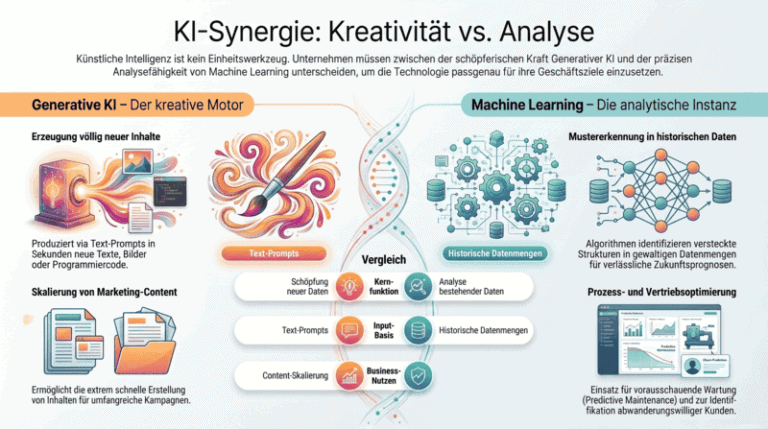
In practice, these two technologies solve entirely different business problems. Generative AI scales your content for marketing campaigns at an incredibly fast rate. Machine learning, on the other hand, optimises predictive maintenance – that is, proactive machine maintenance in production. The analytical algorithms also identify customers at risk of leaving in sales via churn prediction. The precision with which the technology fits the task determines to a large extent how successfully artificial intelligence drives businesses forward.
Off-the-shelf SaaS tools vs. bespoke AI models
You don’t necessarily have to build AI yourself to successfully master the technological complexity. Decision-makers often dread huge IT projects when they want to drive forward AI initiatives within their own companies. For over 90 per cent of businesses, ready-made, out-of-the-box SaaS tools are entirely sufficient. Systems such as ChatGPT Enterprise, DeepL or Jasper provide functions that are ready for immediate use without the need for months-long IT projects.
You only need your own, extensively trained models for very expensive, specialised cases. If you want to use AI in your business, ready-made tools will save you a huge amount of time and money. Training a bespoke model consumes enormous resources. This investment is only worthwhile if your core business is based on extremely specific, proprietary data structures.
Using artificial intelligence in business: practical benefits
Pure theory is of little use if there is no practical application in day-to-day operations. Every decision-maker must clearly define where the software creates real added value for the team. This is where it becomes apparent in practice whether artificial intelligence really drives a business forward.
Increased efficiency and measurable business benefits
AI is not an end in itself, but a directly measurable lever for your company’s growth. Automating repetitive tasks saves your team valuable hours every day. According to the Bitkom 2025 study, 59 per cent of employees expect significant time savings through the consistent use of technology. The algorithms also drastically reduce error rates in manual data processing.
The greatest benefit clearly lies in freeing up staff resources. As soon as artificial intelligence relieves companies of tedious routine tasks, your staff can refocus their attention. They immediately invest the time freed up in core strategic tasks or creative projects. This focus has a direct positive impact on your turnover.
Linking artificial intelligence and corporate knowledge
AI finally makes the isolated, siloed knowledge of individual departments usable across the entire organisation. The approach of linking artificial intelligence to corporate knowledge immediately breaks down old document structures. The workflow for corporate communications is extremely straightforward. An employee simply provides some bullet-point notes from a meeting. A language model immediately transforms this input into a finished press release via a targeted prompt. This approach completely eliminates the manual, time-consuming writing process. The model requires only error-free, factual base data as essential input.
In modern knowledge management, AI acts as a smart, internal search engine. The software searches through thousands of internal PDFs and manuals in a matter of seconds. It answers employees’ natural questions with precise facts. The system also provides direct source references from the company’s documents. When artificial intelligence supports businesses in this way, it eliminates the need for hours of searching through folder structures. For this use case, the IT department simply needs to store the central company PDFs as clean input data.
Quick wins for marketing, sales, HR and support
Always start your automation process with the departments that are easiest to digitise. Implementation requires quick wins in day-to-day work:
- Marketing: Tools handle copywriting and deliver creative content ideas at the touch of a button.
- Customer service: Chatbots act as first-level support, filtering out standard enquiries before a human intervenes.
- Sales: Smart algorithms automatically assess potential customers based on their likelihood of converting (lead scoring).
- HR department: Algorithms draft job adverts and quickly pre-screen hundreds of CVs.
Our experience at Zündstoff Marketing shows that such ‘quick wins’ break down internal resistance extremely quickly. In this way, artificial intelligence delivers immediate, tangible added value to businesses.
Artificial Intelligence: Leading Companies & Costs
The market for smart software is divided into various highly profitable segments. Before you approve budgets, you need to understand the cost structures precisely. Only with the right partner can artificial intelligence safely transform businesses.
AI value chain and criteria for shares
The global AI economy can be divided into three highly profitable segments. This structure reveals the true winners of the boom:
- Hardware manufacturers: These companies produce essential AI chips and high-performance semiconductors.
- Infrastructure providers: These so-called hyperscalers provide massive cloud data centres.
- Software applications: These providers deliver ready-to-use SaaS solutions with intelligent AI integration.
Hardware manufacturers and cloud infrastructure providers act as the classic ‘shovel sellers in the gold rush’. They benefit massively from the general demand for infrastructure. When analysing leading artificial intelligence companies for B2B shares, look out for hard indicators. A strong technology company requires recurring enterprise revenue and a deep economic moat. Reliance solely on third-party API interfaces poses a massive risk. Without proprietary technology, many AI providers will ultimately fail in the market.
B2B AI providers and agencies in the DACH region
The DACH region offers high-calibre AI solutions for B2B use that are fully compliant with data protection regulations. When AI drives the digitalisation of European companies, strict data security is paramount.
The following four AI product providers are shaping the DACH market:
- Aleph Alpha (Germany): The company provides data protection-compliant text generation and data structuring for enterprise clients and public authorities.
- DeepL (Germany): The global market leader structures translations on a global scale and drastically reduces communication costs. According to ElectroIQ’s DeepL Statistics 2025, DeepL recently increased its valuation to US$2 billion.
- Neuroflash (Germany): This software provider supports marketing teams in generating content quickly.
- Merantix (Germany): The venture builder develops industry-specific process automation for SMEs.
On the product side, these providers cover the entire spectrum – from text generation and data structuring to deep process automation.
On the implementation side, specialist agencies support the roll-out of these technologies within organisations:
- Zündstoff Marketing (Switzerland): Our specialist agency implements structured AI visibility and SEO processes within organisations.
Selection criteria for AI software and server location
Security and strict data protection are the most important criteria when selecting your software. If artificial intelligence is to transform businesses in Europe, the GDPR inevitably comes into play. A local EU server location is absolutely essential for corporate data sovereignty. Under no circumstances may your customers’ data leave the European legal jurisdiction unencrypted during processing.
When selecting tools, decision-makers must ensure that ISO 27001 certification is in place. This ISO certification guarantees verified standards in information security. In practice, you will usually be comparing secure on-premises solutions with pure cloud APIs from the US. Local on-premises solutions offer you maximum control over all data. Cloud solutions often scale more quickly, but place significantly higher data protection demands on your IT department.
How much do AI tools cost? Licences vs. API tokens
AI tools require a completely new understanding of modern software budgets. You need to have a precise understanding of the two common pricing models to plan your budget realistically. According to the Inference Pricing Guide 2026, ChatGPT Enterprise currently costs around 60 US dollars per user per month. This Enterprise model requires an annual contract and a fixed minimum purchase of 150 licences.
The underlying cost structures on the market differ fundamentally. With fixed monthly user licences (seats), you pay a fixed amount per employee. The actual level of usage plays absolutely no role in this. This licensing model offers maximum planning certainty when AI is transforming a business from within. In direct contrast to this are usage-based cost models (pay-per-use). Here, you pay exactly according to token consumption via an API interface. One token roughly corresponds to a fragment of a word. Very high volumes of text generation cause your API costs to rise variably under this model.
Artificial Intelligence Guidelines for Businesses: 5 Steps
A structured roll-out is key to the technology’s success in day-to-day operations. Without clear guidelines, an uncontrolled proliferation of unsecured tools can quickly arise. Zündstoff Marketing recommends clear, measurable metrics in this case, so that AI can guide the company safely into the future.
Steps 1 & 2: Data Classification and Tool Selection
Start with an agile approach and resolve existing bottlenecks first, rather than launching a cumbersome large-scale IT project straight away. In the first step, you determine how artificial intelligence can strategically support the company. Through data classification, you define exactly which internal information is permitted to feed into the algorithms. This is essential for minimising existing GDPR risks. Sensitive customer data, contracts or trade secrets must never be stored in public, free-to-use tools. The standard version of ChatGPT is one such high-risk system.
In the second step, you focus on selecting the right tools. You must only choose GDPR-compliant systems for your organisation. We recommend purchasing closed enterprise licences rather than the free public versions. Only dedicated enterprise environments guarantee absolute data security. With these licences, the software provider does not secretly use your sensitive business data to train its own language models.
Steps 3 & 4: Code of Conduct and pilot groups
Transparency and a phased roll-out protect your business from legal and operational risks. In the third step, you develop a clear Code of Conduct for all departments. Implementing a well-founded policy on artificial intelligence across the entire organisation minimises legal risks enormously. These internal guidelines must include a labelling requirement for AI-generated content as well as clear rules on copyright.
In the fourth step, you start with small, closed pilot groups. You begin with highly motivated teams and automate simple routine tasks – the so-called ‘low-hanging fruit’. You only scale up the use of the systems across the board once these pilot groups have achieved initial success. This isolated approach prevents frustration as AI transforms the company technologically.
Step 5: Prompting as a new core competence
A powerful AI tool is completely worthless without trained staff, as the output is only ever as good as the input. The fifth step therefore focuses on comprehensive prompting training. Simply purchasing the software is never enough to boost productivity. Organisations must establish internal guidelines and provide in-depth training to ensure precise communication with the machine.
Formulating precise instructions – known as ‘prompting’ – is the crucial new core competence in the digital office. Only trained teams can use the tools profitably and effectively in day-to-day work. Without this training, staff produce unusable results, causing many artificial intelligence companies to burn through vast amounts of money.
Change Management: Building Employee Acceptance
The success of AI stands or falls on the psychological security of the entire workforce. As a manager, you must directly address this fundamental hurdle and the fear of impending job loss. Remaining silent inevitably leads to resistance within the team. This resistance arises immediately when AI is introduced into a company without warning.
From day one, consistently position the new software as an assistance system – your digital co-pilot. Make it absolutely clear to your staff: AI does not replace people. It simply relieves them of tedious routine tasks. If you take this human aspect into account in change management, you will build genuine acceptance and turn the technology into a benefit for everyone involved.
Summary
The strategic use of off-the-shelf software solutions saves valuable working time and ensures long-term business success. Strict internal guidelines specifically minimise all data protection risks for the organisation. Actively involving staff through practical prompt-based training ultimately determines actual productivity in day-to-day work. Zündstoff Marketing recommends the following approach: start with small pilot groups in selected departments before purchasing comprehensive software licences for the entire team.
Frequently asked questions about AI in business
Is ChatGPT the best AI?
ChatGPT Enterprise is currently regarded as the leading standard for text generation and data analysis in everyday office life. However, according to Zündstoff Marketing, in practice this depends heavily on the specific use case. For specialised technical translations, for example, DeepL delivers significantly more accurate results. Companies must select the software precisely according to the task at hand.
Which AI is better than ChatGPT?
The superiority of a system depends entirely on its intended use. Claude by Anthropic often processes extremely long documents with noticeably greater precision than ChatGPT. When it comes to generating images, Midjourney and DALL-E dominate the market. In terms of local data security, European models score highly thanks to full compliance on their own servers.
Who is the market leader in AI?
OpenAI dominates the market for generative language models with ChatGPT. As the undisputed market leader, Nvidia holds a monopoly on the manufacture of essential high-performance chips for servers. When it comes to providing cloud infrastructure for machine learning, Microsoft, Amazon and Google share the global market share.