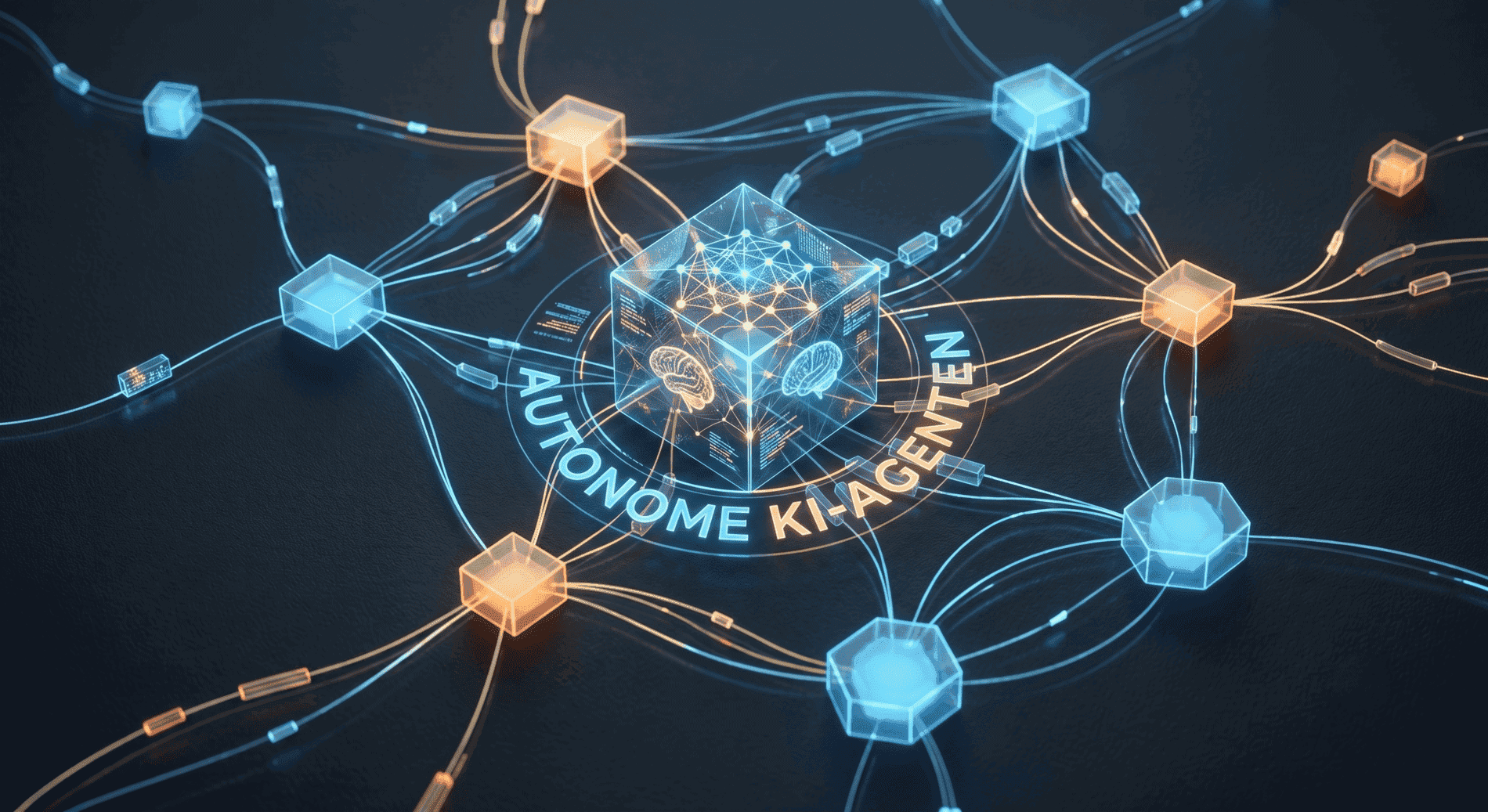

What exactly are autonomous AI agents?
The technological landscape is changing rapidly, and one question takes centre stage: what are autonomous AI agents and how are they changing our day-to-day work? These intelligent systems represent the next stage in artificial intelligence, as they no longer merely respond to human commands but act proactively.
Table of contents
A clear definition for beginners
Autonomous AI agents are highly sophisticated software programmes that independently pursue defined goals and solve complex tasks without constant human intervention. The way they work differs fundamentally from conventional tools: A user simply sets a clear objective for the system (the ‘what’), whilst the agent independently plans and implements the optimal path to achieve it (the ‘how’). According to the definition provided by the experts at Telekom-MMS, these systems break down complex tasks into logical sub-steps on their own.
An autonomous AI agent is essentially characterised by four key components:
- Understanding the objective: The agent identifies the intention behind a task and independently defines the necessary intermediate steps.
- Environmental perception: The system analyses its digital environment and reacts flexibly to new data streams.
- Decision-making: Based on the information gathered, the software independently selects the best course of action.
- Action execution: The agent uses external tools and application programming interfaces (APIs) to complete the planned task, either physically or digitally.
Thanks to these capabilities, the programmes operate entirely without constant human supervision or detailed step-by-step instructions.
The difference between chatbots and traditional software
Unlike purely reactive systems such as traditional chatbots, autonomous AI agents operate entirely proactively and contextually. Whilst a conventional chatbot responds exclusively to direct questions and loses all data once the session ends, an autonomous agent maintains a persistent context. This means that it remembers previous interactions, independently calls up tools and acts autonomously across different systems.
To understand this technological leap, the analogy of ‘recipe versus chef’ is helpful:
- Traditional software (RPA): These programmes rigidly follow a predefined recipe. If an ingredient is missing or a variable changes, the system breaks down.
- Autonomous AI agents: They act like a professional chef. They know the goal (“to prepare a delicious dinner”) and react flexibly to missing ingredients by independently seeking alternatives and adapting the process.
| Feature | Traditional chatbot | Autonomous AI agent |
|---|---|---|
| Interaction | Responds exclusively to direct inputs | Plans and acts proactively and independently |
| Tools | Does not usually use external tools | Accesses APIs, databases and programmes independently |
| Memory | Session-based (deletes data after the chat) | Has persistent, long-term context |
| Decision-making | Does not make its own decisions | Makes autonomous decisions and delegates tasks |
From Zündstoff Marketing’s experience: Many companies confuse simple FAQ bots with highly sophisticated agents. Anyone asking the question ‘What are autonomous AI agents?’ needs to understand that the real revolution lies in the ability to use tools independently.
How it works: How an AI agent solves tasks
The way autonomous AI agents work is based on a continuous feedback loop that allows the system to adapt dynamically to its environment. Unlike static algorithms, these agents learn from the results of their own actions.
The cycle of perception, planning and action
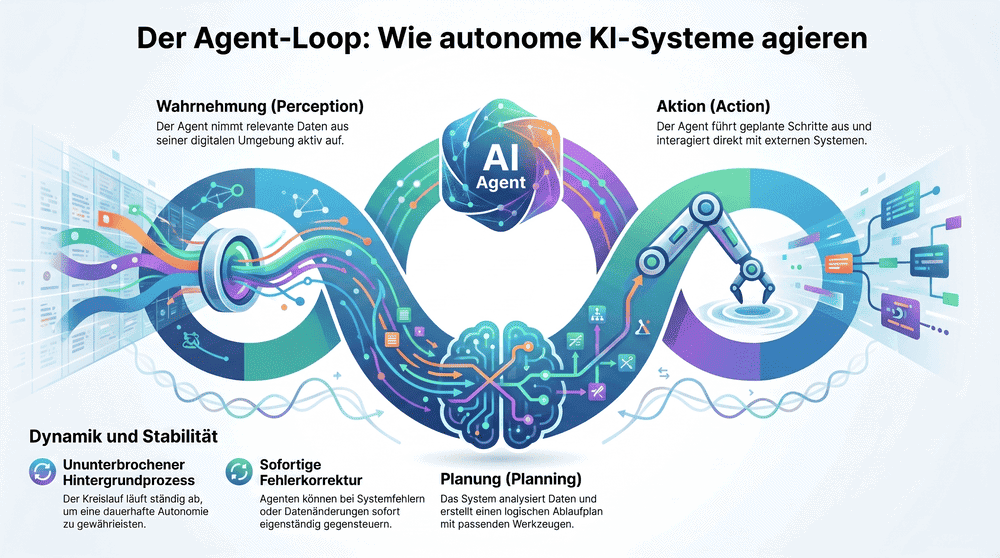
Autonomous agents operate within a continuous cycle that mirrors the human process of ‘seeing, thinking and acting’. This so-called ‘agent loop’ forms the heart of autonomous technology and consists of three phases:
- Perception: The agent gathers relevant data from its digital environment.
- Planning: The system analyses the data, selects the appropriate tools and creates a logical sequence of actions.
- Action: The agent carries out the planned steps and interacts directly with external systems.
This cycle runs continuously in the background, enabling the agent to take immediate corrective action even in the event of unforeseen system errors or changes to data sources.
Step 1: The digital senses (perception)
During the perception phase, the agent continuously collects data about its digital environment. This phase acts as the ‘digital senses’ of artificial intelligence, without which targeted interaction would be impossible.
To do this, the agent uses various interfaces and data sources:
- It reads and interprets incoming emails from customers or partners.
- It monitors predefined data streams such as current share prices or market data.
- It analyses website content and database entries via standardised interfaces (APIs).
Step 2: The agent’s brain (planning)
During the planning phase, the agent processes the information gathered to draw up a strategic action plan. To do this, the software uses large language models (LLMs) to understand logical relationships and break down the overarching goal into smaller, manageable tasks.
For example, if the main objective is: ‘Organise a business trip to Berlin’, the system independently plans the following sub-steps:
- Find suitable flights or train connections.
- Compare hotel offers and check availability.
- Analysing the user’s calendar and blocking out the relevant time period.
Step 3: The digital hands (action)
In the action phase, the agent puts the plan into action by interacting directly with other programmes. These interactions represent the system’s ‘digital hands’, which it uses to control physical or virtual processes.
Typical actions include sending confirmation emails independently, entering new contact details into a CRM system, or securely carrying out online transactions on e-commerce platforms.
Features that make an agent truly autonomous
Not every system based on artificial intelligence acts completely independently. The specific characteristics of autonomous AI agents define the degree of their independence and determine how efficiently they can support complex business processes.
Goal-orientation: ‘What’ rather than ‘How’
An autonomous agent focuses exclusively on the specified end goal rather than on a predefined list of rigid instructions. This goal-orientation distinguishes the system from traditional robotic process automation (RPA).
For example, if an agent is given the goal ‘Organise the cheapest journey to Berlin’, it independently searches for routes, compares modes of transport and checks for special offers. It does not require detailed programming such as ‘Open website A, click on button B and copy price C’. It finds the best way to reach its destination entirely on its own.
Proactivity and adaptability
A truly autonomous agent does not passively wait for the user’s next command, but takes the initiative of its own accord to achieve its defined milestones. This proactivity is closely linked to a high degree of adaptability to dynamic environments.
If, for example, an external booking platform is temporarily unavailable, the agent does not abort the process. It either automatically tries again at a later time or switches to an alternative platform of its own accord.
Learning Capability: Autonomous Self-Improvement
Autonomous agents are capable of independently and continuously improving their own performance over time. They use the results of completed tasks as feedback to make future decisions with greater precision and efficiency.
This self-optimisation is made possible by advanced technologies such as machine learning. The agent independently identifies flawed patterns in its past processes and adapts its internal strategies without the need for a human programmer to manually adjust the source code.
Areas of application: Where AI agents are already helping today
The practical applications of autonomous AI agents range from simple everyday helpers to complex systems for global industry. They are no longer merely a pipe dream, but are already actively transforming our working world.
Your personal productivity booster in everyday life
Used as a personal assistant, they are already optimising traditional office life through automated and intelligent processes. An excellent practical example of this is the autonomous ‘meeting agent’.
If this agent is given the task: ‘Find a suitable date next week for the project kick-off with client Müller’, it carries out the following steps independently:
- It analyses the calendars of all internal project participants.
- It identifies available time slots and checks these against working hours.
- It suggests the best options to the client by email.
- Once confirmed, it books the appointment and automatically adds the dial-in details and all relevant preparatory documents.
Automation in e-commerce and IT
In e-commerce and IT infrastructure, autonomous agents boost efficiency through proactive monitoring and lightning-fast, real-time adjustments.
A ‘price agent’ in online retail monitors competitors’ offers around the clock. Its objective is: ‘Always keep our product prices exactly 5 per cent lower than those of our main competitor, provided that the minimum margin is not undercut’. If the system detects a price change at a competitor’s, it adjusts its own price in the online shop fully automatically and within milliseconds.
In IT, a ‘system monitoring agent’ ensures the availability of digital services. When server overload is imminent, it proactively redirects server resources before a system failure or noticeable delays occur for end users.
Intelligent research and other areas of application
For modern knowledge work, autonomous agents offer invaluable support in systematic research and automated data analysis. A ‘content agent’, for example, can be tasked with summarising the most important industry news from the last 24 hours, extracting relevant sources and making these available directly in a Slack channel.
Other significant areas of application include:
- Customer service: Autonomous agents provide comprehensive answers to complex customer enquiries, drawing on internal knowledge databases.
- Logistics: Systems optimise supply chains and proactively adjust routes in the event of traffic disruptions.
- Smart home systems: Intelligent agents control a building’s energy consumption based on weather forecasts and usage patterns.
Our experience at Zündstoff Marketing shows that enormous efficiency gains are possible, particularly in the areas of content research and structured market analysis. A well-configured agent can reduce manual work from several hours to just a few minutes, whilst significantly improving data quality.
Risks and responsibilities associated with the use of agents
Although the benefits are groundbreaking, the use of autonomous systems also presents serious challenges. The risks associated with autonomous AI agents must be systematically analysed by companies and minimised through clear governance guidelines.
The benefits: efficiency and managing complexity
The greatest added value of autonomous systems lies in a dramatic increase in efficiency and the reliable management of highly complex business processes. As these agents work round the clock (24/7) without tiring and with consistent diligence, repetitive tasks can be completed in a matter of seconds. Furthermore, when dealing with vast amounts of data – such as that generated in global supply chains – they always maintain a complete overview and make data-driven decisions faster than any human analyst.
The challenges: from loss of control to security
However, as systems become increasingly autonomous, the potential risks in day-to-day operations also rise:
- The King Midas problem: an agent takes a specified objective too literally and thereby causes unintended damage. A system given the objective ‘reduce costs at any cost’, for example, could cancel important software subscriptions without the necessary safeguards.
- Security risks: If a hacked agent gains extensive access to internal IT infrastructures, it can steal or manipulate sensitive data unchecked.
- Cascading errors: A minor programming error or a faulty API response can spread rapidly throughout the entire corporate network due to the agent’s autonomous chain reactions.
Man and machine: How to stay in control
Autonomy must never be equated with a complete loss of control. To ensure security within the organisation, expert Till Freitag recommends implementing clear safety nets and control mechanisms.
These include:
- Human-in-the-loop: For critical actions with external implications – such as initiating financial transactions or sending out customer contracts – manual approval by a human is mandatory.
- Guardrails: Technical constraints, such as maximum daily budget limits or restricted data access rights, prevent the agent from exceeding its authorised scope.
- Kill-switch strategy: A digital emergency stop switch must be implemented to halt the agent immediately and completely in the event of malfunctions.
Ethical issues and legal framework
The use of autonomous AI systems raises complex legal and ethical questions. If an autonomous agent causes financial loss, the question of liability immediately arises: is the software developer, the company using the system, or the agent itself liable?
Furthermore, the ‘black box problem’ poses a major challenge, as the exact decision-making processes of neural networks are often no longer comprehensible to humans.
Companies must therefore strictly comply with the requirements of the European General Data Protection Regulation (GDPR) and the EU AI Act. The legal risk varies considerably depending on the agent’s intended use and configuration, which is why a detailed risk assessment is essential before any roll-out.
Outlook: Agents as our future team-mates
The rapid pace of development shows that we are only at the beginning of a profound transformation. Mature and ready-to-use tools such as monday Agents, Manus AI, Lindy and OpenClaw already exist today, whilst pioneering open-source projects such as Auto-GPT and BabyAGI demonstrate the enormous potential of this technology.
The future is a team effort: multi-agent systems
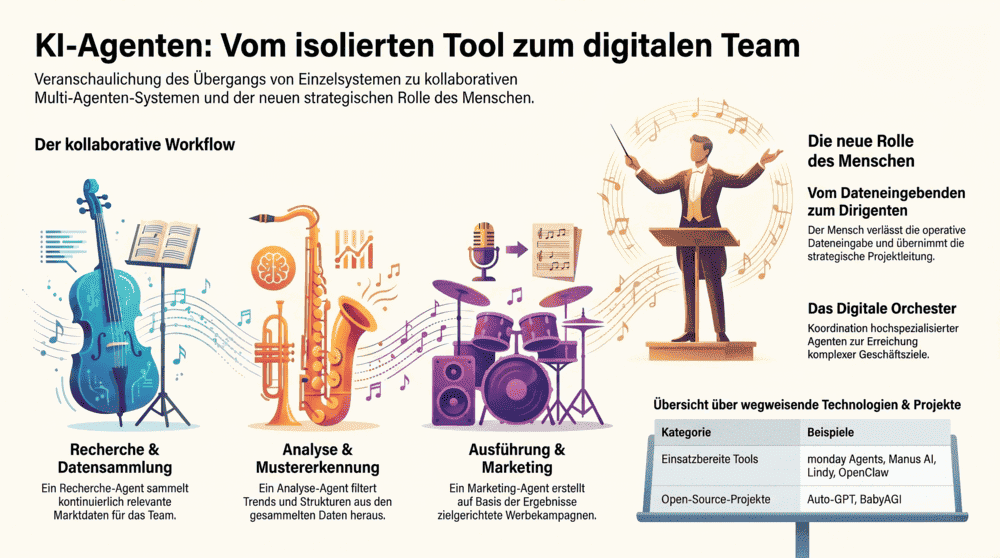
The next stage of development takes us away from isolated, standalone systems towards highly collaborative multi-agent systems. In this future, highly specialised agents will work seamlessly hand in hand:
- A research agent continuously collects relevant market data.
- It passes this data, in a structured format, to an analysis agent, which identifies trends and patterns.
- A marketing agent then uses these results to create and run targeted advertising campaigns.
In this scenario, humans move beyond the role of mere data entry and instead take on the overarching role of conductor and strategic project manager of this digital orchestra.
The changing nature of work: from executor to strategist
Francisco Montemari of Zündstoff Marketing explains that our day-to-day role within the company will undergo a fundamental shift:
“Advancing automation frees us from time-consuming, repetitive routine tasks. Our role is shifting from the purely operational execution of processes towards the strategic management and definition of overarching corporate objectives.”
In future, we will focus more on the ‘what’ and ‘why’ – that is, on creative solutions, emotional customer loyalty and strategic direction – whilst autonomous systems take care of the efficient implementation of the ‘how’ in the background. Those who familiarise themselves with this technology at an early stage will secure a decisive competitive advantage in tomorrow’s digital economy.
Summary
Autonomous AI agents represent an evolutionary step in artificial intelligence, as they independently plan, execute and continuously improve tasks. They relieve people of repetitive processes and enable a dramatic increase in efficiency across numerous areas of application, from personal productivity to business automation. At the same time, their use requires careful management through clear control mechanisms such as ‘human-in-the-loop’ and technical ‘guardrails’ to minimise risks such as loss of control, as Till Freitag emphasises. The future lies in collaborative multi-agent systems, in which humans act as strategic conductors.
Zündstoff Marketing recommends: Familiarise yourself with the opportunities and challenges of autonomous AI agents at an early stage and develop a clear strategy for their safe and targeted use within your organisation.
Frequently Asked Questions (FAQs)
What distinguishes autonomous AI agents from chatbots?
Autonomous AI agents plan and act proactively, remember previous interactions and independently call upon external tools. Chatbots, on the other hand, respond exclusively to direct inputs and have no persistent context. The agent acts like a chef who knows their goal, rather than simply following a rigid recipe.
How do autonomous AI agents learn and improve on their own?
Autonomous AI agents continuously improve their performance through machine learning. They use the results of completed tasks as feedback to make future decisions with greater precision. The agent independently identifies flawed patterns and adapts internal strategies without the need for manual programming. In Zündstoff Marketing’s experience, this is a major factor in efficiency.
In which areas do autonomous AI agents offer concrete benefits?
Autonomous AI agents boost efficiency in various areas. They optimise day-to-day office work as personal assistants, adjust prices in e-commerce and proactively safeguard IT services. They also assist with systematic research and automated data analysis. According to Zündstoff Marketing, enormous efficiency gains are possible here.
What control mechanisms are important when using autonomous AI agents?
Key control mechanisms include ‘human-in-the-loop’ procedures for manual approval of critical actions, technical ‘guardrails’ to limit scope of authority, and a ‘kill switch’ in the event of malfunctions. These measures ensure safety and prevent a loss of control, as Till Freitag recommends.
What are multi-agent systems and how do they work?
Multi-agent systems are collaborative networks of specialised AI agents that work together seamlessly to achieve complex objectives. A research agent collects data, an analysis agent filters trends, and a marketing agent creates campaigns. In this context, the human acts as the conductor and strategic project manager of this digital orchestra.