
📋 Table of contents
How ChatGPT Ads work and what context-based advertising means for GEO
ChatGPT Ads provide not only organic visibility within AI systems but also paid access to users who are researching products, services and potential solutions within a conversation. The self-service Ads Manager has also been available to advertisers in Switzerland since the end of August 2026. OpenAI also announced on 31 August that, less than 200 days after its launch, ChatGPT Ads had reached an annualised revenue rate of one billion US dollars and was already being used by tens of thousands of advertisers. Source: OpenAI, 31 August 2026
For marketing professionals, it is not so much the size of the new advertising channel that is of interest as the way it works. ChatGPT Ads are not based solely on individual search terms. When selecting an advert, OpenAI takes into account, amongst other things, the context and intent of the current conversation. This means that the matching process differs from traditional keyword logic. Source: OpenAI, Ads in ChatGPT, The Basics
ChatGPT Ads are available in Switzerland
OpenAI launched the first ChatGPT Ads trial on 9 February 2026 in the US. On 18 August, the company announced its expansion to 31 European markets. Self-service access via Ads Manager for Europe followed at the end of August. OpenAI’s current availability list explicitly lists Switzerland as a market with self-service access available. Source: OpenAI, Ads Manager Availability
Ads may appear to users on the Free and Go plans. According to OpenAI’s current information, the Plus, Pro, Business, Enterprise and Edu plans remain ad-free. Ads are labelled as sponsored content and displayed separately from the actual ChatGPT response. Source: OpenAI, Ads in ChatGPT
OpenAI now reports more than one billion weekly active ChatGPT users. However, this does not mean that advertisers can automatically reach this entire audience. Ad-free subscriptions, regional availability, age restrictions, sensitive conversation contexts and the advertising system’s relevance checks limit the target audience that can actually be reached. Source: OpenAI, 31 August 2026
How ChatGPT Ads work
OpenAI describes its own advertising system as one that selects adverts based on expected relevance and expected outcomes. This involves combining several signals. These include the context and intent of the current conversation, the advertiser’s landing page, the ad’s title and description, so-called ‘context hints’ and targeting settings. When ad personalisation is enabled, selected signals from broader ChatGPT usage may also be taken into account. Source: OpenAI, Ads in ChatGPT
| Signal | Significance for ChatGPT Ads |
|---|---|
| Conversation context | The system takes into account what the user is talking about in the current chat. |
| Conversational intent | The intent behind the conversation is factored into the relevance assessment. |
| Context Hints | Advertisers describe conversations, topics or terms where their offer might be relevant. |
| Landing Page | The content of the landing page is one of the relevance signals identified by OpenAI. |
| Ad text | The title and description are taken into account during selection. |
| Targeting | Geographical targeting and Custom Audiences, amongst other things, are supported. |
| Bid | The bid, together with relevance, is factored into the ad auction. |
This way of working changes the way paid campaigns are planned. A user does not have to reduce their need to two or three search terms. They can formulate a problem, their requirements, constraints and decision-making criteria in natural language. The advertising system can use this conversational context for matching. Source: OpenAI, 31 August 2026
Context Hints instead of traditional keyword logic
An important feature for advertisers is what are known as ‘Context Hints’. These are set at ad group level and describe conversations, topics or keywords where a product or service might be relevant.
OpenAI expressly points out that Context Hints are not exact-match keywords and do not guarantee ad delivery in response to a specific conversation. Rather, they provide the system with additional context for matching user intent with the offer. Source: OpenAI, Ads in ChatGPT, The Basics
The recommendations on ad design also reflect this approach. OpenAI recommends specific, benefit-focused copy that describes the practical benefits of an offer, who it is intended for, and in what situations it can be helpful. Generic advertising claims therefore provide the system with less context than clearly defined use cases. Source: OpenAI, Create Ads for ChatGPT Ads
Assessment by Zündstoff Marketing: ChatGPT Ads should not currently be structured as copies of existing Google Ads campaigns. A structure based on specific customer problems, decision-making situations and use cases makes sense. Context hints and ad variations can then be tailored to these situations. Controlled campaign tests and conversion data should be used to determine which structure actually delivers better results.
How the ad auction works
According to OpenAI, ChatGPT Ads uses a relevance-weighted second-price auction. This means that, when there are several suitable adverts, the highest bid is not the sole deciding factor. The system takes into account a combination of relevance and bid amount. OpenAI describes the aim of the auction as maximising value for advertisers and users. Source: OpenAI, Ads in ChatGPT, The Basics
Currently, CPM and CPC campaigns, amongst others, are supported. For CPC campaigns, OpenAI specifies a recommended initial maximum CPC of between 3 and 5 US dollars in its documentation. In addition, OpenAI has introduced conversion optimisation. Metrics available for measurement include impressions, clicks, CTR, average CPC, average CPM and conversions. OpenAI Pixel, the Conversions API and UTM parameters can be used to measure performance. Source: OpenAI, Ads in ChatGPT, The Basics
What user data is taken into account in Switzerland
When it comes to personalisation, a distinction must be made between the current conversation and additional user signals. OpenAI can use information from the current chat to select an advert. This is supplemented by basic contextual information such as the general region or language. According to OpenAI, the private conversations themselves are not shared with advertisers. Source: OpenAI, Ads in ChatGPT
In markets where ad personalisation is enabled, past chats and ‘Memory’, as well as previous interactions with adverts, may also be taken into account. According to OpenAI, this personalised advertising is not initially available for the European Economic Area and Switzerland. Swiss advertisers should therefore not assume that the US personalisation model can be applied unchanged to Swiss campaigns. Source: OpenAI, Ads in ChatGPT
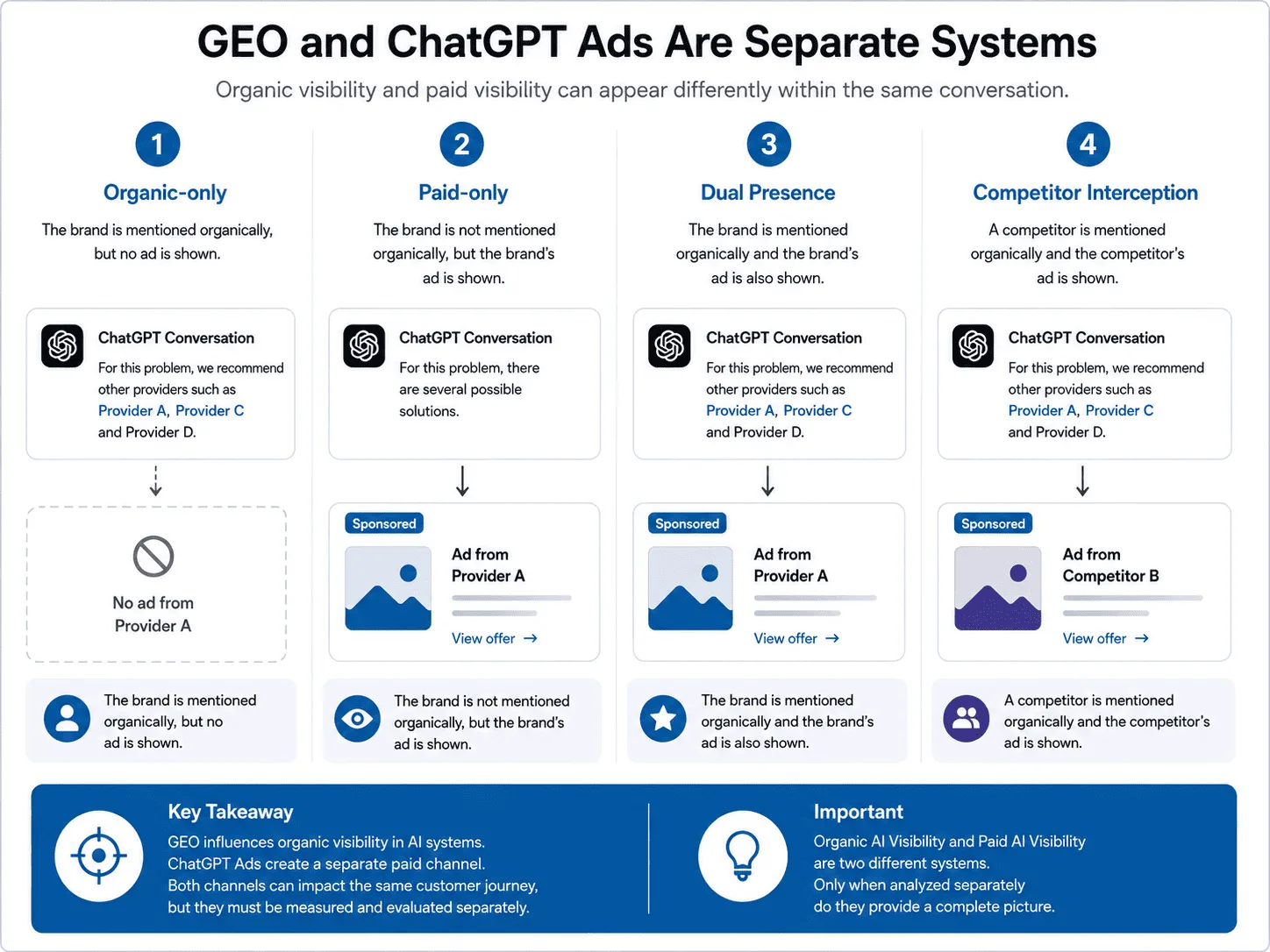
GEO and ChatGPT Ads are separate systems
A clear distinction must be made regarding the relationship between Generative Engine Optimisation (GEO) and ChatGPT Ads. OpenAI explicitly states that advertising does not influence ChatGPT’s responses. Adverts run on separate systems. Advertisers can neither purchase ChatGPT’s organic responses nor alter their order via ad bids. Furthermore, the display of an advert does not imply that OpenAI is recommending the advertiser. Source: OpenAI, Ads in ChatGPT
There is currently no published evidence from OpenAI to suggest that a brand’s high organic GEO visibility automatically leads to a better advert position, a lower CPC or a higher probability of the advert being displayed. Statements such as ‘GEO first, then ChatGPT Ads’ cannot therefore be justified as a technical requirement of the advertising system.
Nevertheless, the connection remains relevant for marketing analysis. A company may be mentioned organically in a ChatGPT response, appear as a paid advert, be visible in both areas, or in neither. Similarly, ChatGPT may mention a brand organically, whilst an advert from a competitor appears directly below the response.
| Situation | Organic AI Visibility | Paid AI Visibility |
|---|---|---|
| Organic-only | Brand is mentioned or quoted | No own advert |
| Paid-only | Brand is missing from the response | Own advert appears |
| Dual presence | Brand is mentioned organically | Your own advert also appears |
| Competitor Interception | Your own brand is mentioned | A competitor’s advert appears |
This distinction is crucial for measuring success. Organic AI visibility and paid AI visibility should not be combined into a single metric. Only then can we analyse the contribution each area makes to website visits, leads, conversions and revenue.
What initial data from the US shows
As ChatGPT Ads were launched earlier in the US, initial observational data is already available there. This data should not yet be regarded as a universally applicable benchmark. However, it does provide insights into how paid and organic content can co-exist within ChatGPT.
In an analysis updated in July 2026, Seer Interactive examined 3,697 observed ChatGPT adverts. In just 5.4 per cent of these adverts did the respective advertiser also appear in the organic ChatGPT response. In 3.3 per cent of cases, the advertiser was also cited as the source. Source: Seer Interactive, updated on 28 July 2026
The data does not show whether organic visibility improves the performance of a ChatGPT advert. However, it does show that a paid placement does not require a prior organic mention. Paid advertising can therefore create visibility in conversational contexts where a brand does not appear in the organic ChatGPT response.
Seer also investigated which adverts appear in response to direct questions about a specific brand. In only 7.3 per cent of these brand-related prompts did an advert for the brand the user had asked about also appear. This means that the advertising space for such queries often remains open to other providers. Seer documented, for example, a case in which a competitor used this space to position itself as an alternative to the brand being searched for. The study is based on an early market phase with approximately two weeks’ worth of observation data. The results may change significantly as ChatGPT Ads become more widespread. Source: Seer Interactive, 28 July 2026
What Swiss SMEs can take away from this
For Swiss SMEs, the current state of development argues against a hasty shift of large existing advertising budgets towards ChatGPT Ads. The channel is still in its infancy, and OpenAI is constantly expanding formats, targeting options, bidding strategies and measurement capabilities. At the same time, there is still a lack of long-term benchmarks for the Swiss market regarding CPC, conversion rate, CPA and return on ad spend.
Recommendation from Zündstoff Marketing Existing budgets from Google Ads, LinkedIn or Meta should not be shifted solely because of the current buzz surrounding ChatGPT Ads. For companies with suitable target audiences, a limited test is advisable to begin with. Campaigns should be structured around clearly defined use cases and measured using robust conversion tracking. What matters is not impressions or clicks alone, but qualified leads, conversions, cost per acquisition and the resulting business value.
At the same time, organic visibility should be monitored. It is important to note which brands ChatGPT mentions in response to relevant questions, which competitors are cited, in which topics the company’s own brand is absent, and which adverts appear in the same conversational contexts. Combining this data provides a more complete picture than an isolated analysis of GEO or paid media.
For businesses, this does not imply a mandatory sequence from SEO through GEO to ChatGPT Ads. A more sensible approach is a shared measurement framework with separate channels. On the one hand, there is organic AI visibility; on the other, paid AI visibility. Both can influence the same customer journey, but must be attributed separately.
Summary
ChatGPT Ads expand paid media to include an advertising channel in which conversational context and user intent play a central role in matching. To achieve this, OpenAI combines, amongst other things, the current chat context, intent, landing page, ad content, context hints, targeting and bids. Where there are multiple suitable adverts, a relevance-weighted second-price auction is used. Source: OpenAI, Ads in ChatGPT, The Basics
GEO and ChatGPT Ads should remain technically separate. OpenAI does not recognise organic brand authority as a ranking factor for adverts and explicitly separates advertising from the generated responses. Initial data from the US also shows that organic and paid visibility can coexist within the same conversation.
For Swiss companies, this presents a new measurement challenge. What matters is not only whether a brand is visible in ChatGPT, but also how this visibility is achieved and what contribution it makes to business results. Zündstoff Marketing therefore recommends initially conducting controlled tests of ChatGPT Ads and tracking paid data, GEO data and conversion data separately before making any major budget decisions.
Frequently Asked Questions (FAQs)
What are ChatGPT Ads?
ChatGPT Ads are paid advertisements labelled as sponsored, which may appear separately from a ChatGPT response. OpenAI selects advertisements based on expected relevance and results. Source: OpenAI, Ads in ChatGPT
Are ChatGPT Ads available in Switzerland?
Yes. Switzerland is currently listed by OpenAI as a country with self-service access to Ads Manager. Source: OpenAI, Ads Manager Availability
How does ChatGPT select adverts?
OpenAI takes into account, amongst other things, the context and intent of the current conversation, the landing page, the ad’s title and description, context hints, targeting and bids. When personalisation is enabled, additional signals from ChatGPT usage may be taken into account in supported markets. Source: OpenAI, Ads in ChatGPT
Are context hints comparable to keywords?
Only to a limited extent. Context hints may contain topics and keywords, but according to OpenAI, they do not function as exact-match keywords. They describe conversational situations and topics in which an offer might be relevant, but do not guarantee delivery in response to a specific prompt. Source: OpenAI, Ads in ChatGPT, The Basics
Do ChatGPT Ads influence organic responses?
No. OpenAI explicitly states that adverts run on separate systems and that advertisers cannot influence, purchase or alter the order of ChatGPT responses. Source: OpenAI, Ads in ChatGPT
Does a company need GEO before running ChatGPT Ads?
No. There is currently no technical requirement for this, nor has OpenAI published any evidence to that effect. Initial data from Seer Interactive shows that, out of 3,697 adverts analysed, only 5.4 per cent of advertisers appeared simultaneously in the organic ChatGPT response. GEO may be relevant for organic AI visibility, whilst ChatGPT Ads represent a separate paid channel. Source: Seer Interactive, 28 July 2026
Which metrics can be measured for ChatGPT Ads?
The Ads Manager currently includes, amongst other things, impressions, clicks, spend, CTR, average CPC, average CPM and conversions. For conversion measurement, OpenAI provides, amongst other tools, OpenAI Pixel and the Conversions API. UTM parameters can also be used for existing analytics systems. Source: OpenAI, Ads in ChatGPT, The Basics
Should Swiss SMEs already be testing ChatGPT Ads?
Whether a trial is worthwhile depends on the target audience, the offering, profit margins, the existing data set and the available advertising budget. As self-service access is available in Switzerland, businesses can test campaigns. Zündstoff Marketing recommends, in the current market phase, a clearly limited test budget, defined conversion goals and a comparison with existing paid channels before allocating larger budgets.