
📋 Table of contents
ChatGPT leads the way – but the comparison needs to be put into context
When reports speak of an AI search engine market with ChatGPT at the top, it must first be clarified which metric is being referred to. User share, search volume, reach within an AI platform and referral traffic to external websites are different metrics and must not be equated with one another.
When it comes to website referral traffic, a recent SE ranking analysis of 101,574 websites from 250 countries paints a clear picture: In 2026, ChatGPT will account for around 74.78 per cent of the referral traffic generated by AI platforms worldwide. Google Gemini follows with 11.56 per cent, Perplexity with 7.23 per cent, Microsoft Copilot with 3.51 per cent and Claude with 2.62 per cent. In 2025, ChatGPT still held 79.74 per cent. Its share is therefore falling, whilst Gemini and Claude, in particular, are growing faster. However, this does not mean that ChatGPT is losing traffic in absolute terms: its referral traffic has continued to grow. (Source: SE Ranking – AI Traffic Research 2026)
The key is to interpret these figures correctly: these figures do not show the user or market share of the AI platforms. They measure solely what proportion of the website traffic generated by AI systems originates from which platform. A platform may therefore have a very large number of users but send comparatively little traffic to external websites, or vice versa.
AI search tools vs. the overall search market – what the figures really mean
Measured against total website traffic, direct visits from AI platforms remain small. According to SE Ranking, their global share rose from 0.02 per cent in 2024 to 0.24 per cent in 2025 and to around 0.32 per cent in 2026. By contrast, organic search still accounted for 42.75 per cent of all website visits in the same dataset in 2026. AI referral traffic is therefore growing very rapidly, but in absolute terms it remains on a completely different scale to traditional search engines. (Source: SE Ranking – AI traffic in the DACH region in 2026)
A regional analysis is particularly interesting for the German-speaking market. In the DACH region, total AI referral traffic in 2026 averaged around 0.38 per cent of website traffic, which is slightly above the global average of 0.32 per cent. At the same time, the platform mix is significantly more balanced: ChatGPT accounts for around 65.42 per cent of AI referral traffic in the DACH region in 2026, down from 75.46 per cent the previous year. Perplexity accounts for 15.30 per cent, whilst Gemini has also grown significantly. ChatGPT, Perplexity and Gemini together generate 95.37 per cent of AI referral traffic in the DACH region. (Source: SE Ranking – DACH Study 2026)
These regional differences illustrate why global market share figures alone fall short when it comes to Swiss companies. The platforms relevant to a target audience can vary significantly depending on the market, language and user behaviour.
Google AI Overviews are deliberately not included in this list as a further source of referral market share alongside ChatGPT or Perplexity. AI Overviews are an integral part of Google Search and not a standalone platform with a separately comparable referral market share. They influence search traffic on a different level: users receive answers directly within Google’s search results, which can eliminate traditional organic clicks.
For businesses, this means that ChatGPT, Gemini, Perplexity and other AI platforms create additional information and brand touchpoints. Google AI Overviews, on the other hand, directly alter existing search behaviour within Google. Both developments are relevant to SEO and GEO, but must be analysed separately.
How ChatGPT, Perplexity and Google AI Overviews differ technically
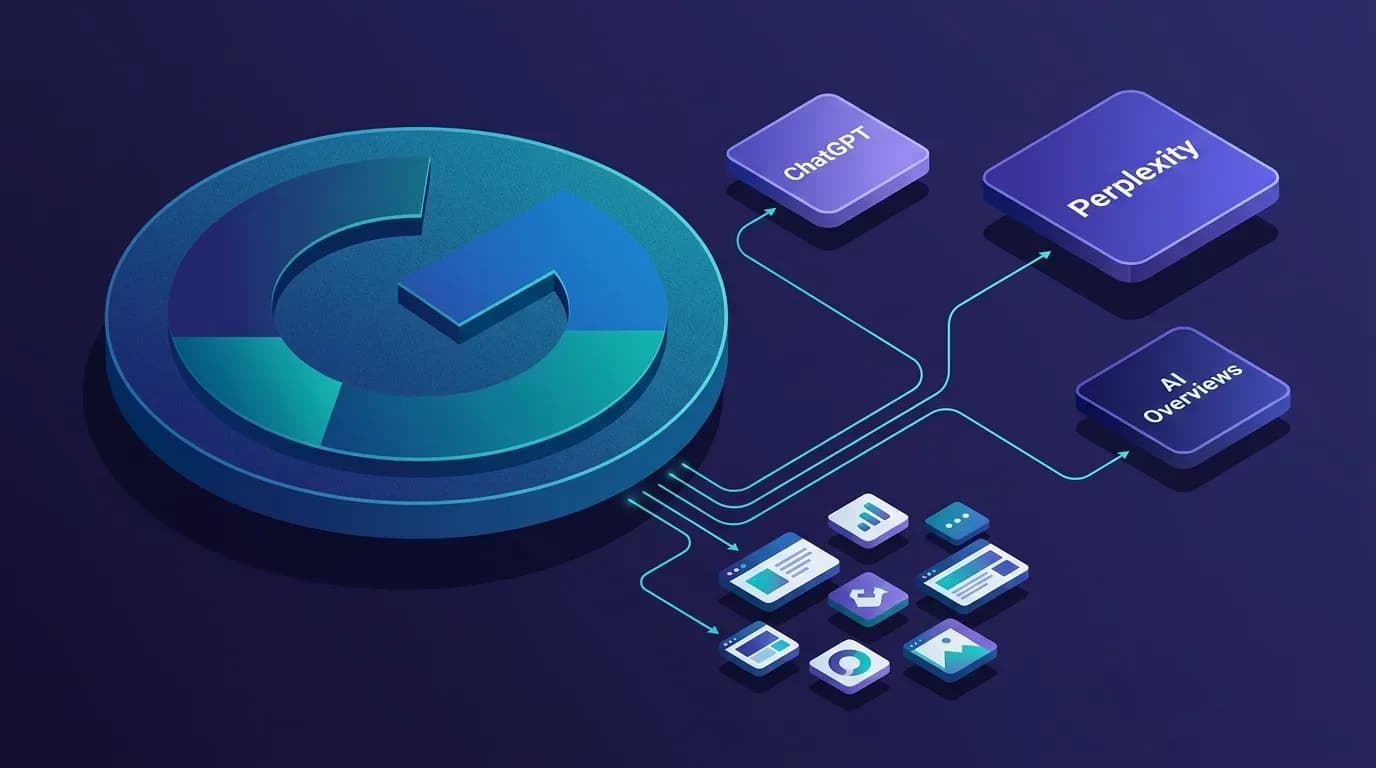
ChatGPT Search, Perplexity, Google AI Overviews and Microsoft Copilot can incorporate information from the web into AI-generated answers. However, their selection of sources is not identical. For businesses, this means that a website frequently cited on one platform does not automatically achieve the same visibility on another platform.
A direct comparison of response coverage and source selection
Between 26 February and 3 March 2025, SE Ranking analysed a total of 2,000 English-language ‘how-to’ keywords across 20 sectors in the US market. The analysis reveals significant differences in response coverage and source selection. Important: The percentage figures for answer coverage measure the proportion of test queries for which the respective system generated an answer. They are not a measure of whether a corresponding proportion of the answers was factually correct. (Source: SE Ranking – AI Search Engine Comparison)
| Key metric | ChatGPT | Perplexity | Google AI Overviews | Bing Copilot |
|---|---|---|---|---|
| Response coverage in the test | 99.90% | 99.95% | 58.15% | 72.60% |
| Average age of cited domains | 17 years | 14 years | 17 years | 12 years |
| Proportion of cited domains under 5 years old | 11.99% | 8.53% | 7.45% | 18.85% |
| Overlap of domains with ChatGPT | – | 25.19% | 21.26% | 13.95% |
The study shows one thing above all: the platforms do not draw on an identical pool of sources. ChatGPT and Perplexity still had the greatest overlap in their cited domains, at 25.19 per cent. Between Google AI Overviews and ChatGPT, the figure was 21.26 per cent. Bing Copilot’s choice of sources differed even more markedly from the other systems. (Source: SE Ranking)
Search intent also plays an important role in Google AI Overviews. Ahrefs analysed 146 million search results pages and found that 99.9% of keywords featuring ‘AI Overview’ had at least one informational intent. AI Overviews appeared in around 20.5 per cent of the SERPs examined overall, but were significantly more common for question-based searches and longer queries. As keywords can have multiple intent categories simultaneously, this does not mean that AI Overviews appear exclusively for purely informational search queries. (Source: Ahrefs – What Triggers AI Overviews?)
From Zündstoff Marketing’s practical experience: reach alone is not enough to prioritise an AI platform. The decisive factors are the search intents for which a system is used, the sources it selects, and the role the platform plays in the target audience’s information-gathering and decision-making process.
Which domains do the platforms cite, and why?
Another striking difference lies in the age of the cited domains. In the SE Ranking study, the domains linked to by ChatGPT and Google AI Overviews were on average 17 years old. For Perplexity, the average was 14 years, and for Bing Copilot, 12 years.
Average domain age of cited sources by AI platform
Source: SE Ranking
There was also a difference for domains less than five years old: Bing Copilot cited such domains in 18.85 per cent of the cases examined, ChatGPT in 11.99 per cent, Perplexity in 8.53 per cent and Google AI Overviews in 7.45 per cent. Conversely, 49.21 per cent of the domains cited by Google AI Overviews were older than 15 years. For ChatGPT, the figure was 45.80 per cent; for Perplexity, 42.31 per cent; and for Bing Copilot, 31.19 per cent. (Source: SE Ranking)
However, it cannot be concluded from this that domain age itself is a direct ranking or citation factor. Older domains often also have more extensive content, more external mentions, backlinks, brand awareness and topical authority built up over the years. Domain age can therefore correlate with other signals of authority and trust without being the cause of them.
It is also worth noting that traditional SEO strength is not a prerequisite for an AI citation. In the SE Ranking study, 12.64 per cent of the analysable URLs cited by the AI systems had no measurable organic Google traffic. Many other cited pages had only low traffic and backlink values. This suggests that, in addition to established sources, AI systems can also take into account specialised content that does not hold a dominant position in traditional organic search traffic. (Source: SE Ranking)
What Google AI Overviews mean for your traffic in practical terms
For businesses, Google AI Overviews represent one of the most immediate changes in search behaviour, as they provide answers directly on the search results page. This allows users to partially satisfy their information needs without visiting the underlying websites.
For an updated study, Ahrefs analysed 300,000 keywords and aggregated Google Search Console data. For keywords that triggered an AI Overview in December 2025, the average click-through rate (CTR) of the top-ranking page fell from around 7.3 per cent in December 2023 to around 1.6 per cent in December 2025. As the CTR for informational keywords without an AI Overview also fell during this period, Ahrefs additionally calculated a comparative figure. Without an AI Overview, a CTR of around 3.7 per cent would have been expected for the group of keywords analysed. The difference compared to the actual CTR of around 1.6 per cent corresponds to an estimated additional decline of approximately 58 per cent. (Source: Ahrefs – AI Overviews reduce the click-through rate by 58 per cent)
The effect is not limited to position 1. In the same study, Ahrefs found an average CTR impact of −50.8 per cent on position 2, −46.4 per cent on position 3, −38.8 per cent on position 4 and −32.6 per cent on position 5. These figures are study results and do not represent a fixed loss of traffic for every website. Industry, query, device, SERP layout and user intent significantly influence the actual impact. (Source: Ahrefs)
The Pew Research Centre also observed a change in clicking behaviour. The study analysed 68,879 Google searches carried out by 900 US adults. On search results pages featuring an AI summary, users clicked on a traditional search result in 8 per cent of visits. Without an AI summary, the figure was 15 per cent. A source link within the AI summary was clicked on in only around 1 per cent of the corresponding visits. (Source: Pew Research Centre)
This does not mean that traditional rankings are becoming meaningless. A good ranking continues to increase visibility and can boost both clicks and the likelihood of being recognised as a relevant source by search and AI systems. However, the economic value of a position can no longer be assessed solely on the basis of rankings and organic clicks.
The measurement logic is therefore changing for businesses. In addition to rankings, impressions and clicks, new questions are becoming important: Is the brand mentioned in generative answers? Is the company’s own website cited as a source? In what context does the brand appear? Which competitors are mentioned? And can AI visibility later be linked to leads, enquiries or turnover?
How Swiss companies are building platform-specific visibility
It is particularly important for Swiss companies not to adopt international benchmarks uncritically. Much research on generative search is based on US or English-language search queries. At the same time, the latest SE ranking data shows that the DACH region already differs significantly from the global average.
In 2026, ChatGPT’s share of global AI referral traffic will be 74.78 per cent. In the DACH region, however, it will be only 65.42 per cent. Perplexity will reach 15.30 per cent in the DACH region, making it significantly stronger than its global figure of 7.23 per cent. This shows that Swiss companies should not base their platform prioritisation solely on global figures. (Source: SE Ranking – DACH Study 2026)
Caution is also required when interpreting domain age. Whilst the available studies show that established domains account for a large proportion of the cited sources, this does not prove the existence of an inherent ‘domain age bias’. For Swiss SMEs, therefore, it is not the age of a domain that is the decisive factor for optimisation, but rather the systematic building of topical authority, traceable entities, high-quality content, external mentions and clear brand associations.
GEO instead of SEO – what changes in practice
Generative Engine Optimisation (GEO) focuses on structuring content and digital brand signals in such a way that companies can be found, understood, mentioned or cited as a source by generative search and response systems.
GEO does not replace traditional search engine optimisation. SEO and GEO overlap in many fundamental aspects: technical accessibility, clear page structures, high-quality content, verifiable facts, structured information and digital authority remain relevant. A new consideration is how a company is represented within generative responses and linked to topics, products, people or categories.
Francisco Montemari, founder of Zündstoff Marketing, puts the difference as follows: “SEO optimises for discoverability and clicks; GEO extends this logic to include mentions and citations in AI responses. Today, the two go hand in hand.”
The available research reveals varying patterns:
- ChatGPT: The SE ranking data shows a broad selection of sources, including many established domains, but also specialised sources and those with lower traffic volumes. For businesses, therefore, clear, fact-based content and consistent brand and entity signals are key.
- Perplexity: The platform is strongly source-oriented. In the search engine ranking analysis, 1,980 of the 1,999 Perplexity responses examined each contained exactly five sources. As a result, up-to-date, precise and well-sourced content is particularly well-suited to serving as citable building blocks of information.
- Google AI Overviews: Organic Google visibility remains relevant, but is not a mandatory prerequisite for a citation. An updated Ahrefs analysis of 863,000 keyword SERPs and around four million AI Overview URLs in 2026 revealed that only around 38 per cent of the pages cited in AI Overviews also appeared in the top 10 for the same search query. (Source: Ahrefs – 38% of AI Overview Citations Pull From The Top 10)
The updated Ahrefs data is significant because earlier research had found a much stronger overlap between top-10 rankings and AI Overview citations. This trend illustrates just how rapidly generative search systems are evolving. Through ‘query fan-out’, Google can execute several related search queries, thereby incorporating sources that do not necessarily appear on the first results page for the original search query.
A completely identical GEO strategy for all platforms therefore falls short. At the same time, a completely separate content strategy for each AI system would be inefficient. It makes more sense to have a common SEO and GEO foundation upon which platform-specific optimisations can be built.
Zündstoff Marketing therefore pursues a combined approach for Swiss SMEs: first, establishing the technical and content foundations; then assessing on which platforms a brand already appears, where competitors dominate, and which topics or gaps in sources exist. Only then are measures prioritised according to platform and business relevance.
Zündstoff Marketing’s Perspective
There is no one-size-fits-all answer to the question of which AI platform Swiss companies should focus their resources on. Current data shows, particularly in the DACH region, just how quickly the balance of influence is shifting between platforms.
For many Swiss SMEs, Google – including AI Overviews – remains a key priority. Google has a direct influence on existing organic search traffic. The latest CTR data also shows that AI Overviews can alter the economic significance of even good rankings. The existing SEO foundation should therefore not be neglected in favour of isolated optimisation for ChatGPT or other AI platforms.
At the same time, ChatGPT is the largest standalone AI referral channel. Globally, around 74.78% of measured AI referral traffic in 2026 comes from ChatGPT. In the DACH region, the figure is 65.42%. The lower regional share does not mean that ChatGPT is unimportant. Rather, it shows that Perplexity and Gemini have a proportionally stronger presence in the German-speaking market than the global average. (Source: SE Ranking)
Perplexity deserves special attention from Swiss companies. Whilst Perplexity’s global share of AI referral traffic fell to 7.23 per cent in 2026, it rose to 15.30 per cent in the DACH region. According to SE Ranking, its absolute referral traffic in this region increased by 62.6 per cent compared with 2025. For this very reason, it would be wrong to assess the platform solely on the basis of global market shares. (Source: SE Ranking)
Gemini is experiencing particularly dynamic growth. Globally, its share of AI referral traffic rose from 4.78 per cent in 2025 to 11.56 per cent in 2026. In the DACH region, absolute Gemini referral traffic grew by 343 per cent year-on-year, according to SE Ranking. The platform should therefore be monitored on an ongoing basis and not underestimated on the basis of older market share data. (Source: SE Ranking)
However, it is crucial to note that referral traffic represents only part of the AI’s impact. A user may become aware of a brand through an AI response without immediately clicking through to the website. A subsequent visit may occur via a direct entry, a Google search, a brand search or another channel. Such interactions are not automatically attributed to the original AI response in traditional analytics systems.
Zündstoff Marketing therefore structures the entry into GEO in two steps: first, assessing the current visibility of the brand and its competitors on relevant AI platforms; then, strategically developing content, entities and external authority. In addition to traditional SEO metrics, AI-specific KPIs such as mentions, citations, share of voice and platform-specific visibility are taken into account.
Summary
AI search is already transforming the way we search for information. However, the greatest risk when interpreting current figures lies in mixing different metrics together.
A share of 74.78% does not mean that ChatGPT controls 74.78% of the entire search market or of AI users. The figure describes ChatGPT’s global share of the measured AI referral traffic to external websites. In the DACH region, this share is already significantly lower at 65.42 per cent. At the same time, total direct AI referral traffic remains comparatively small, accounting for less than one per cent of website traffic.
Key findings:
- AI referral traffic, platform usage and the traditional search engine market are distinct metrics
- ChatGPT leads global AI referral traffic in 2026 with 74.78 per cent, but is losing market share relative to growing competitors
- The DACH market differs significantly from the global average: ChatGPT is weaker, whilst Perplexity and Gemini are stronger
- Google AI Overviews are changing click behaviour within traditional Google Search and must be considered separately from standalone AI platforms
- Only around 38 per cent of the AI Overview citations examined in 2026 appeared simultaneously in the organic top 10 for the same query
- Domain age alone is not a proven ranking factor; authority, content, brand and trust signals must be considered collectively
- SEO remains the foundation, but is enhanced by GEO and a dedicated measurement of AI visibility
Recommendation for action: Zündstoff Marketing recommends a two-stage approach: first, an assessment of current AI visibility on the platforms relevant to the target audience, followed by the structured expansion of the SEO and GEO foundation using platform-specific measures. The key is not to replace SEO with GEO, but to make traditional search visibility and AI visibility measurable together.
Frequently Asked Questions (FAQs)
Which AI search engine has the largest market share?
That depends on the metric used. According to SE Ranking, ChatGPT leads the way in global AI referral traffic to websites in 2026 with 74.78 per cent. Gemini follows with 11.56 per cent, Perplexity with 7.23 per cent, Microsoft Copilot with 3.51 per cent and Claude with 2.62 per cent. These figures do not, however, represent user share or the total search engine market. In the DACH region, ChatGPT’s share is significantly lower at 65.42 per cent. (Sources: SE Ranking – global analysis, SE Ranking – DACH analysis)
How significant is AI referral traffic compared to traditional search?
In the SE Ranking 2026 dataset, AI platforms generated around 0.32 per cent of total website traffic worldwide. Organic search, by contrast, accounted for 42.75 per cent. In the DACH region, the share of AI referral traffic stood at around 0.38 per cent. Direct traffic from AI platforms is therefore growing strongly, but in absolute terms it remains considerably smaller than traffic from traditional search engines. (Source: SE Ranking – AI traffic in the DACH region 2026)
What distinguishes ChatGPT Search, Perplexity and Google AI Overviews?
The systems use different search, retrieval and sourcing mechanisms. In an SE Ranking study of 2,000 keywords, for example, only 25.19 per cent of the domains cited by ChatGPT and Perplexity overlapped. Between ChatGPT and Google AI Overviews, the figure was 21.26 per cent. Visibility on one platform therefore does not guarantee visibility on another. (Source: SE Ranking – AI Search Engine Comparison)
To what extent do Google AI Overviews affect my organic traffic?
Ahrefs found that, for position 1, there was an estimated additional drop in CTR of around 58% when an AI Overview is present. For position 2, the measured effect was −50.8 per cent; for position 3, −46.4 per cent; for position 4, −38.8 per cent; and for position 5, −32.6 per cent. These are average figures based on the keywords analysed and do not represent a guaranteed loss of traffic for every website. (Source: Ahrefs – AI Overviews reduce click-through rates by 58%)
Do users still click on sources in Google AI Overviews?
Yes, but relatively rarely, according to the Pew Research study. On Google search pages featuring an AI summary, users clicked on a traditional search result in 8 per cent of visits, compared with 15 per cent on pages without an AI summary. A source link within the AI summary was clicked on in around 1 per cent of the relevant visits. The study is based on 68,879 Google searches by 900 US adults and is therefore not automatically applicable to the Swiss market on a one-to-one basis. (Source: Pew Research Center)
Does my website have to be in the top 10 on Google to be cited in AI Overviews?
No. An Ahrefs analysis from 2026 examined 863,000 keyword SERPs and around four million AI Overview URLs. Around 38 per cent of the cited pages also appeared in the top 10 for the same query. Good organic rankings remain relevant, but are not a prerequisite for an AI Overview citation. (Source: Ahrefs – 38% of AI Overview Citations Pull From The Top 10)
Is domain age a ranking factor for AI search engines?
The available data does not support a direct correlation between domain age and ranking. SE Ranking merely noted that the domains cited in the test were, on average, 17 years old for ChatGPT and Google AI Overviews, 14 years old for Perplexity, and 12 years old for Bing Copilot. Older domains often have more content, brand awareness, backlinks and external mentions. No direct causality should therefore be inferred from this correlation. (Source: SE Ranking)
Why does my brand appear on one AI platform but not on another?
AI platforms do not draw on identical sources and use different retrieval and response mechanisms. SE Ranking, for example, found only a 25.19 per cent overlap between the domains cited by ChatGPT and Perplexity. A brand may therefore be present in ChatGPT whilst being absent from Perplexity or Google AI Overviews. (Source: SE Ranking)
How often do the various AI search systems generate a response?
In the SE Ranking study, which analysed 2,000 English-language ‘how-to’ keywords, Perplexity generated a response for 99.95 per cent of test queries, whilst ChatGPT did so for 99.90 per cent. Bing Copilot achieved 72.60%, whilst Google AI Overviews appeared in 58.15% of cases. These figures measure response coverage within the sample analysed and should not be equated with actual response accuracy. (Source: SE Ranking)
How much does it cost to be visible in AI search engines?
There is generally no fee charged per placement for an organic mention or citation in ChatGPT, Perplexity or Google AI Overviews. However, costs are incurred for analysis, technical optimisation, content, structured information, brand building and ongoing monitoring. Paid AI advertising formats should therefore be considered separately from organic GEO visibility.
How should I align my GEO strategy across multiple AI platforms?
A sound GEO strategy begins with a common foundation comprising technical accessibility, high-quality content, clear entities, verifiable facts and digital authority. Next, you should assess on which platforms your own brand and its competitors actually appear. Only then can ChatGPT, Google AI Overviews, Gemini, Perplexity and other systems be sensibly prioritised according to target audience and business relevance.