📋 Table of contents
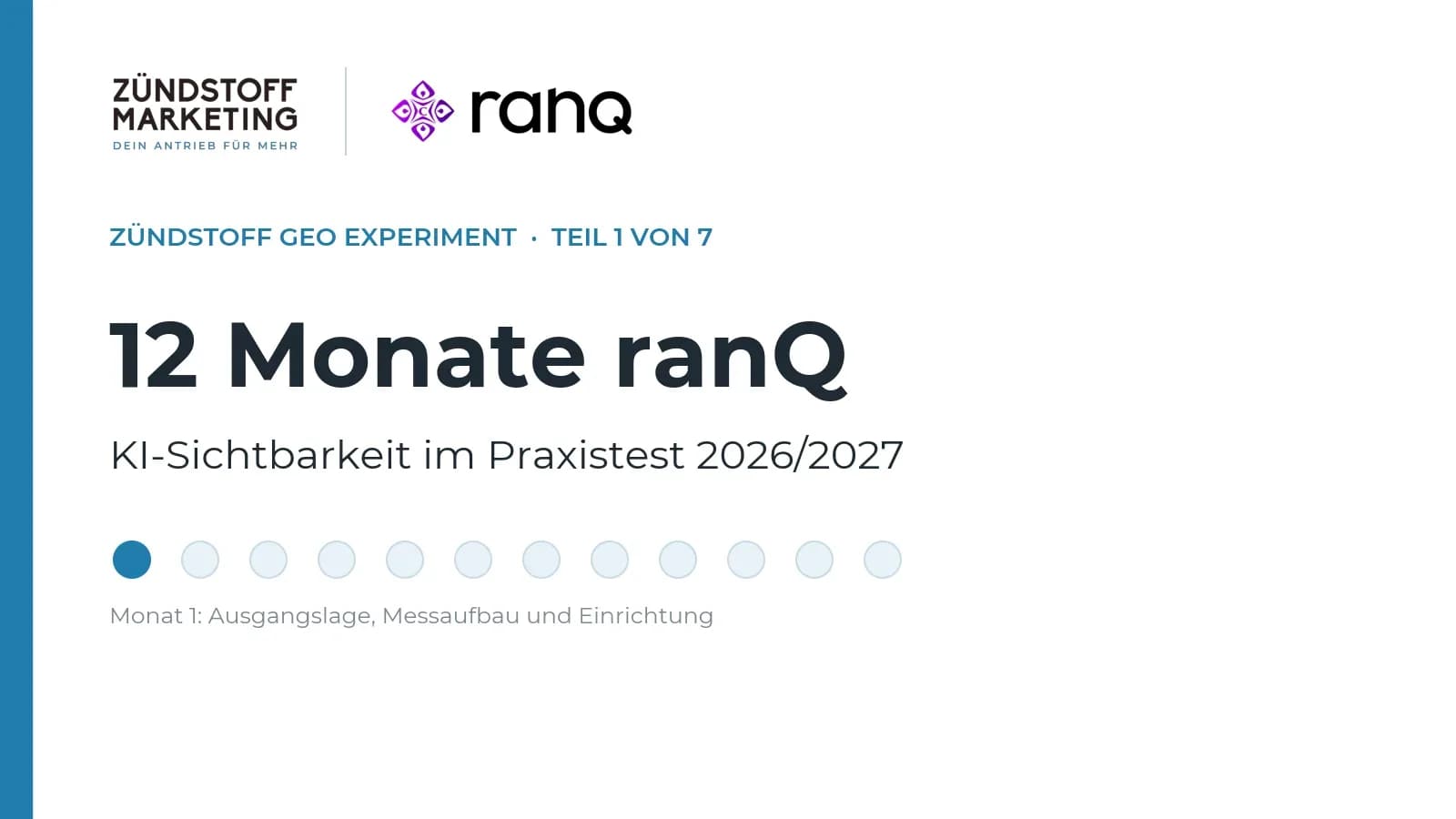
Zündstoff GEO Experiment, Part 1 of 7 · Partnership with ranQ.
I’m spending a year testing whether the Swiss AI business directory ranQ makes my own brand more visible on ChatGPT, Perplexity and Google. Not based on gut feeling, but using independent measurements, fixed questions and metrics available only on ranQ. In this first part, I’ll outline the starting point, the experimental setup and how the implementation went. I’ll also discuss what I found was missing.
The experiment at a glance
| Details | Details |
|---|---|
| Series | Zündstoff GEO Experiment, Part 1 of 7 |
| Duration | 29 October 2026 to 1 November 2027 |
| Brand tested | Zündstoff Marketing, Allschwil (legal entity: Plan26 GmbH) |
| Offer tested | ranQ by cohaga AG, St. Gallen, Command-Plan |
| Independent measurement | Rankscale (46 fixed questions, weekly, Switzerland), SE Ranking and Google Search Console for SEO monitoring, own server logs, GA4, demand assessed for each enquiry |
| AI systems | ChatGPT, Perplexity, Google AI Overviews. Since 9 November 2026, additionally Gemini and Google AI Mode, reported separately |
| Study protocol | Hypotheses and success criteria defined prior to the first results (5 November 2026) |
| Labelling | Partnership with ranQ. |
What is this experiment about?
More and more people are no longer asking Google their questions, but rather ChatGPT, Perplexity or Google’s AI overview. If you’re not mentioned there, you simply don’t exist for these people. This raises a new question for SMEs: how does my business get included in these answers?
Providers such as ranQ promise an answer to this. I want to know whether they deliver on that promise. My key question is therefore:
Does a comprehensive company profile on ranQ improve my brand’s visibility in AI responses, and do AI systems demonstrably use ranQ as a source?
I myself advise companies on GEO and AI visibility. That is precisely why it is important to me that this test remains honest. If something doesn’t work, I’ll report it here just as I would a success.
Why is a new brand an honest test case?
A new brand is an honest test case because it doesn’t have the head start that comes from years of brand recognition. My brand has been around since 2026, but the website in its current form has only been live since 11 August 2026. Hardly anyone knows us yet. There’s been no major press coverage and only one Google review so far.
I created the website entirely using AI. It runs headless with Next.js on the front end and Payload as the back end. I managed and checked every step myself. What began as a test has, step by step, become my online presence. A lot of it was new to me at the start, and not everything worked straight away. Even today, there are still a few things left to do. However, the topic of AI is so fascinating that I’m working on dozens of projects at the same time, which is why I’m only making slow progress on each individual one. That’s why prioritising is so important :-)
It’s only the brand that’s new, not the experience. Behind the brand is Plan26 GmbH, which has been in existence since 2016 and through which I ran my own online shop until 2025. Zündstoff Marketing combines IT expertise with strategic marketing, because its founder, Francisco Montemari, is both a computer scientist and a marketing manager.
This is the ideal starting point for this experiment. Many SMEs find themselves in exactly this position. When ranQ helps an unknown brand, the results are more meaningful than with a well-known name. At the same time, a young brand will become more visible over time even without ranQ. That’s why I work with indicators that are unique to ranQ and with benchmark brands.
Who is ranQ and what does the Command Plan involve?
ranQ is an AI-powered business directory from cohaga AG in St. Gallen. cohaga AG has specialised in Swiss business data for years and, in addition to ranQ, also offers Leadhub for B2B lead generation and Datacare for address management. It is led by Fabio Mätzler, CEO and co-founder, and Isabel Bischof, co-founder and COO. According to the company, the directory comprises over 600,000 Swiss companies and synchronises its master data daily with the Commercial Register (Zefix). The idea behind this is to organise company data, FAQs and specialist articles in such a way that AI systems can read, understand and use them as a source. Each profile is delivered with structured data, i.e. in a format that machines can process directly.
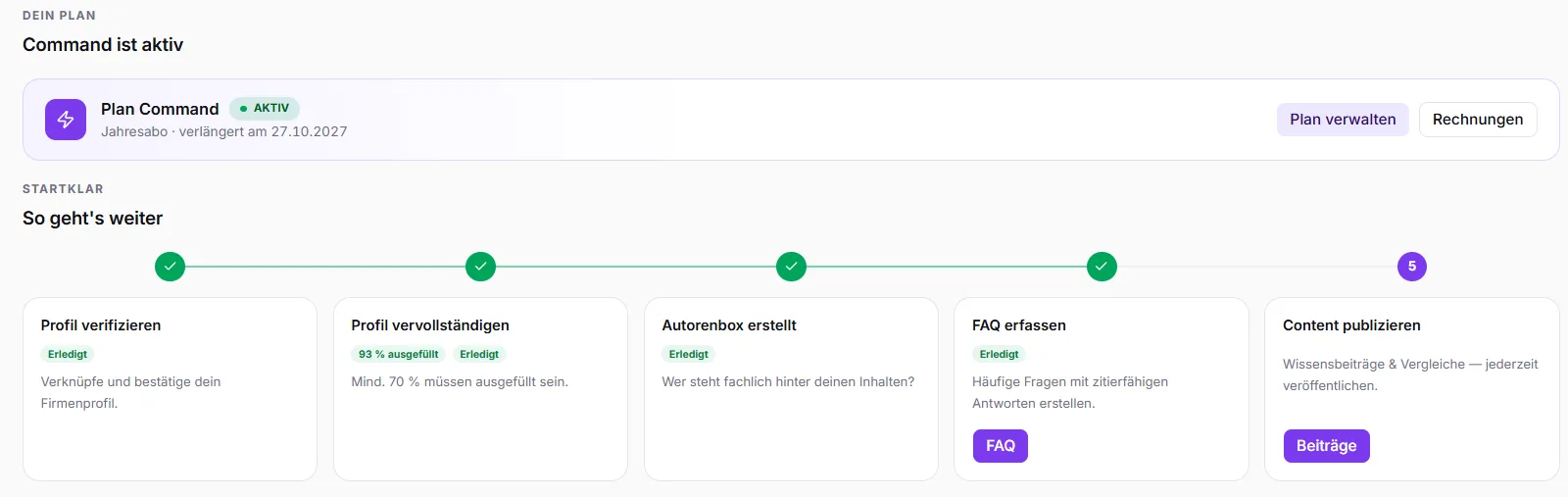
For this experiment, I’m using the Command Plan. It includes:
- a company profile with an author box and 9 FAQs
- monitoring of AI visibility in the ranQ dashboard
- 48 AI checks, around 4 per month
- 12 knowledge articles, one per month
- 3 comparison pages
- an action plan for measures on and off the website
- the AI Trust Badge for your own website
I’ll be using all these services over the course of the year and reporting on them.
Why I’m testing ranQ
I’m testing ranQ because my brand is new and I want to specifically boost its digital visibility – not just on Google, but wherever more and more people are searching for providers. ranQ promises exactly that for Swiss businesses. I advise Swiss SMEs on visibility in ChatGPT, Perplexity and Google AI Overviews, which is why I’m testing this kind of directory on my own brand first before recommending it to others.
One point has further convinced me. A study by Propus Codestudio on German-speaking Swiss SMEs shows that AI systems often refer to directories and platforms rather than companies’ websites (Netzwoche, 29 September 2026). In my own pre-launch metrics, directories such as firmen.ch also appeared as sources for my brand (Rankscale, 30 days up to 27 October 2026). ranQ was not yet listed there.
How do I measure whether ranQ is effective?
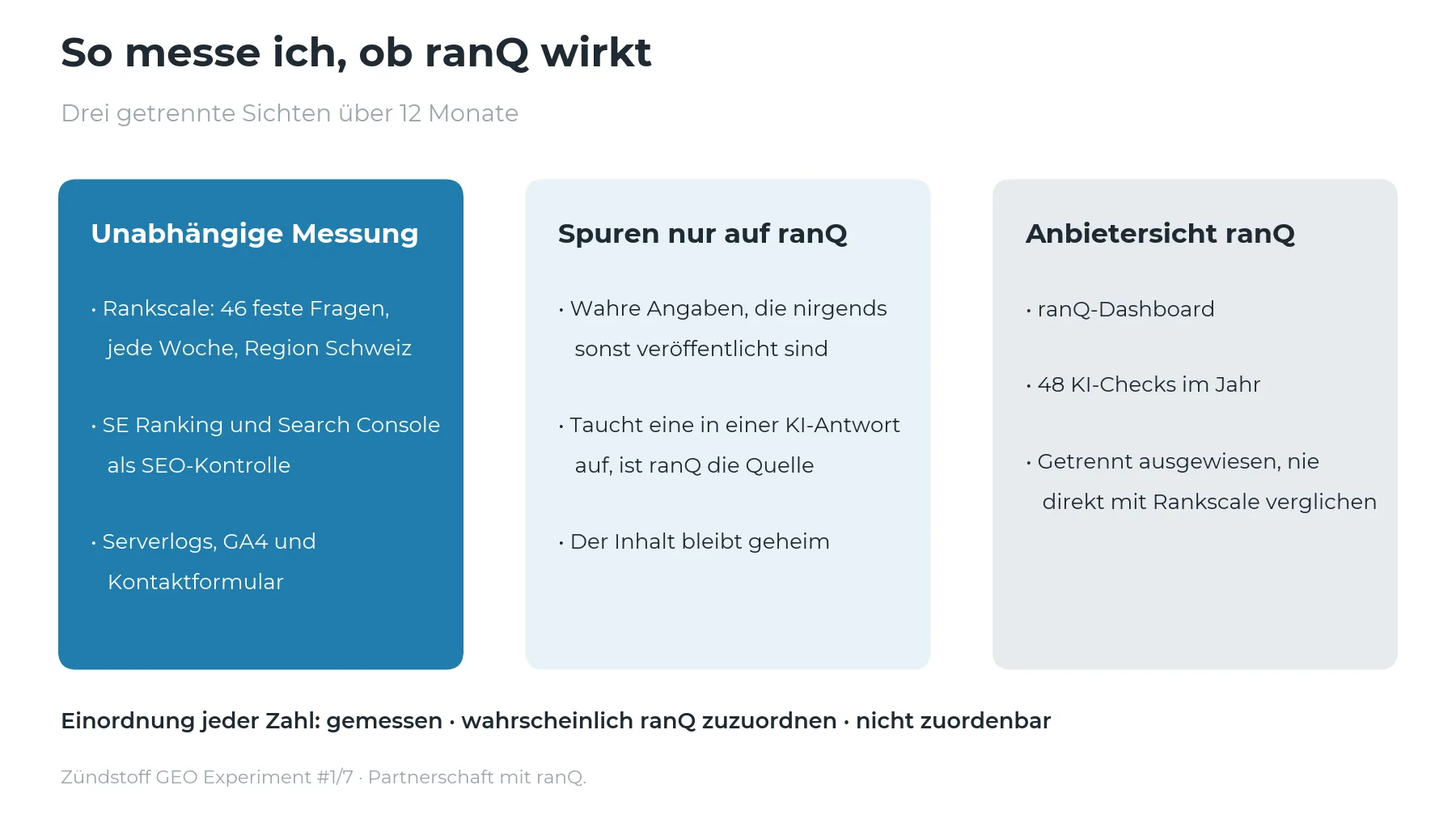
I measure whether ranQ is effective using independent tools and keep these results clearly separate from the provider’s figures. Zündstoff Marketing measures AI visibility using repeatable prompt tests rather than one-off queries, because AI responses fluctuate from week to week and only repeated measurements allow for a reliable conclusion.
Independent measurement
- Rankscale: 46 fixed questions, just as customers would ask them. Every week, covering Switzerland. The questions, AI systems and benchmark brands remain unchanged throughout the year.
- SE Ranking and Google Search Console: as an SEO check. Is AI visibility only increasing because the website is performing better on Google? I want to see that.
- My own server logs: My website runs on my own Ubuntu server (VPS) in Infomaniak’s ethical cloud. There, I can see which AI bots are accessing my website and who is coming from AI platforms or from ranQ.
- GA4 and contact form: Where do visits and enquiries come from?
- Direct enquiries: Anyone who contacts me is asked how they found me – for example, via ChatGPT, Google, ranQ or a recommendation. Many visits originating from AI responses arrive without a recognisable source; the customer’s reply fills this gap.
Provider’s perspective
- The ranQ dashboard and the AI checks. I report these figures separately and never compare them directly with Rankscale.
How can I tell if an AI is using ranQ as a source?
For me, this is the most important part of the experiment. I have published some genuine details on ranQ that do not appear anywhere else – not on my website, nor on LinkedIn. If an AI reproduces any of these details, I can be fairly certain where it came from. I am deliberately not revealing which details these are. Otherwise, the trail would be worthless. Before publication, I carried out a baseline measurement on 29 October. None of the AI responses contained this information. Any subsequent match is therefore a clear indication that ranQ is the source.
How I categorise results
- Measured: every figure, along with the date, source and AI system.
- Likely attributable to ranQ: only in the case of trace matches, quotations from ranq.ch, visits via ranQ, or close temporal proximity to a ranQ action.
- Cannot be attributed: everything else.
How visible was my brand before ranQ?
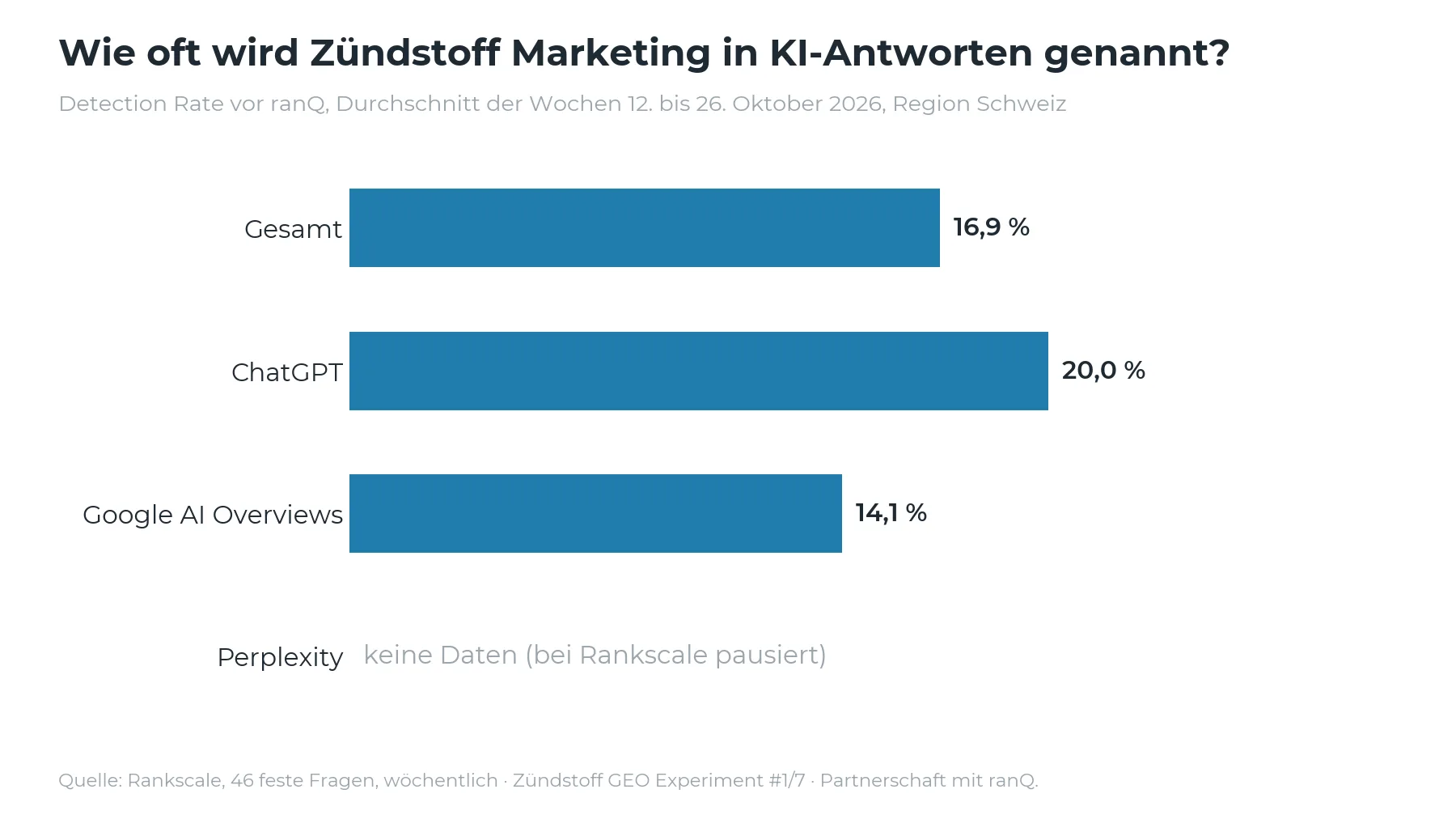
Before the launch, my brand appeared in 16.9% of the AI responses to the 46 fixed questions – that is, in roughly one in six responses (Rankscale, Switzerland region). The baseline figures are taken from the three comparable weeks from 12 to 26 October 2026. Zündstoff Marketing recommends that Swiss SMEs measure the baseline situation over several weeks before any GEO campaign, as progress can only be demonstrated against a fixed baseline value.
| Key figure | Baseline | Source |
|---|---|---|
| Total detection rate (proportion of responses in which the brand is mentioned) | 16.9% | Rankscale, from 12 October to 26 October 2026 |
| ChatGPT detection rate | 20.0% | Rankscale, average from 12 October to 26 October 2026 |
| Detection rate for Google AI Overviews | 14.1% | Rankscale, average from 12 October to 26 October 2026 |
| Perplexity | No data | Paused on Rankscale since 12 October 2026 |
| Average position, where stated | 1.8 | Rankscale, week starting 26 October 2026 |
| Quotes from ranq.ch | 0 | Rank scale, 5 October to 26 October 2026 |
| Match hits | 0 | Baseline measurement 29 October 2026 |
| Google Search Switzerland: Impressions / Clicks / Average Position | 1,384 / 14 / 27.0 | Google Search Console, 1 October to 28 October 2026 |
| ranQ AI Check | 50 out of 100 | ranQ, 29 October 2026 (provider’s perspective) |
What stands out about the current situation?
- When my brand is mentioned, it ranks on average at position 1.8 amongst all providers and tools featured in the answer – meaning it usually appears in first or second place. However, this figure should currently be viewed with great caution, as it is based on only a few mentions and the other providers mentioned vary depending on the question. The problem is not the position, but the frequency.
- The website already appears on Google in Switzerland, but on average only in position 27, meaning it is usually on page three (Google Search Console, 1 October to 28 October 2026). It has only been online in its current form since 11 August 2026. The fact that AI systems still mention my brand – and usually right at the top – is therefore hardly down to traditional Google rankings. This is precisely what makes the test meaningful.
- AI systems confuse my brand with companies of the same name, particularly with a German agency. Their website was cited as a source 153 times in October (Rankscale, 30 days up to 27 October 2026). Clean entity data is therefore no minor issue for me.
What went well during the set-up?
I took over the profile on 29 October 2026 and set it up in two days.
- Quick verification. An automated check wasn’t possible. The manual check was completed the very next day.
- Structured data from the very first minute. The profile, author box and FAQs are delivered in a machine-readable format straight away. My FAQ texts went live unchanged; nothing was automatically rewritten.
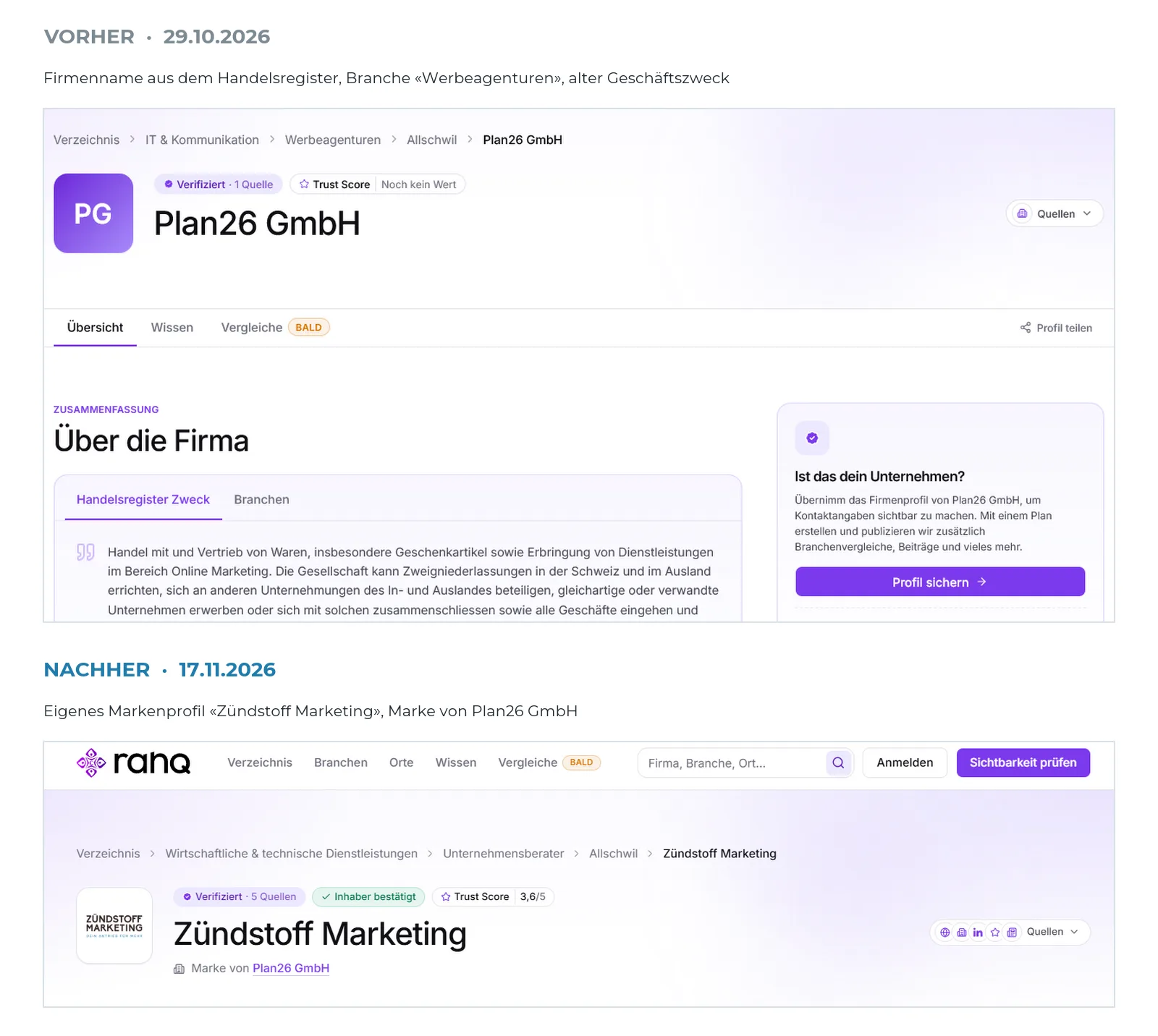
- ranQ listens and delivers. After setting up the profile, I sent ranQ my observations and requests. The most important point was that my brand belongs to Plan26 GmbH and is not a separate company. Initially, the profile only displayed the company name from the commercial register, and the profile link led to plan26-gmbh. Two days after my enquiry, I received a reply from the management. On 6 November, the brand profile was activated, with its own address ranq.ch/unternehmen/zuendstoff-marketing and the clear note ‘Brand of Plan26 GmbH’. To me, this demonstrates two things. ranQ takes feedback from real-world use seriously. And the support team responds not only in a friendly manner, but also quickly.
What was missing from the setup?
I passed these points on to ranQ as suggestions. Some have already been resolved or are under review.
- Brand and company. Initially, there was only one field for the company name. Anyone managing multiple brands under a single limited company couldn’t represent this accurately. This has now been resolved with the brand profile.
- Relevant industry. There was no separate category for marketing, SEO or GEO consultancy.
- No draft mode. Every change goes live immediately.
- A new brand starts from scratch. Initially, the brand profile adopted the GmbH’s year of incorporation, i.e. 2016. When I corrected this to the actual start year, 2026, the ranQ Trust Score dropped from 4.0 to 3.6, because the brand’s established history now counts as zero years (ranQ, 16 November 2026). This is honest and instructive for many SMEs launching a new brand.
- Measurability of visits. Initially, the website link in the profile did not provide any information on the source of traffic. Visits via ranQ were therefore not identifiable on the company’s own website. ranQ has since adjusted this for the link in the contact section; for the second link in the sources menu, this information is currently being requested.
Are there any initial indications yet?
There is one initial observation. In the first weekly measurement on 2 November 2026, around four days after publication, ChatGPT correctly reproduced both links from the ranQ profile and cited ranQ as the source. Google AI Overviews did not include them.
It is striking which pages ChatGPT cited. It was not the German profile page, but the English and French versions of the ranQ profile. ranQ automatically makes each profile available in several languages, and it was precisely these versions that were found. Since 6 November, all content has been available at the brand profile’s new address. The AI systems first need to locate it there, which is why I expect some fluctuations in the short term.
This is an isolated result and does not yet constitute proof. Only the ongoing monitoring will show whether this is confirmed in the coming weeks. The trend is only considered confirmed if a match occurs in at least 3 out of 4 consecutive weeks.
What could skew the results?
An honest test acknowledges its limitations. I am documenting these confounding factors with the date:
- This is an isolated case. There is no genuine control group. The results apply to my brand; they do not automatically apply to every SME.
- New website. Part of any improvement may occur even without ranQ, as AI systems only gradually index new websites.
- Perplexity is missing. Rankscale has paused Perplexity since 12 October 2026.
- Move to the brand profile. Since 6 November 2026, all content has been hosted at a new address. AI systems first need to rediscover it.
- Further measures. I’m continuing to expand the brand in parallel, for example with new directory listings and an Italian version of my website (since mid-November 2026). Everything is logged in the logbook with the date.
- AI responses vary. Models are constantly changing. That is why I take weekly measurements and analyse monthly averages.
What am I expecting, and when would the test be considered a failure?
I defined the success criteria before the first results were available.
| Hypothesis | This is considered confirmed if |
|---|---|
| AI systems pick up content that is only available on ranQ | at least one trace match occurs in at least 3 out of 4 consecutive weeks |
| ranq.ch is cited as the source | the number of citations from ranq.ch is above 0 in at least two monthly measurements |
| My brand is mentioned more frequently | the detection rate in months 6 to 12 is, on average, at least 3 percentage points above the baseline, and the competitor brands do not show the same level of growth |
| People are visiting the website via ranQ and AI | Visits via ranQ are measurable, or AI-driven visits exceed the previous figure |
If a criterion is not met, I will report this just as openly.
What’s next?
The first monthly measurement will follow at the end of November. Part 2 will address the question of what an AI actually needs to know about a company. Using my own ranQ profile, I’ll show which details I’ve included and how I’ve presented them, with a before-and-after comparison.
All parts of the series
- Part 1: Starting point, measurement setup and configuration (this post)
- Part 2: What does an AI need to know about a company? (to be published at the end of November)
Zündstoff GEO Experiment #1/7 · Partnership with ranQ.
All figures include the measurement date and source. I have the raw data to hand.